

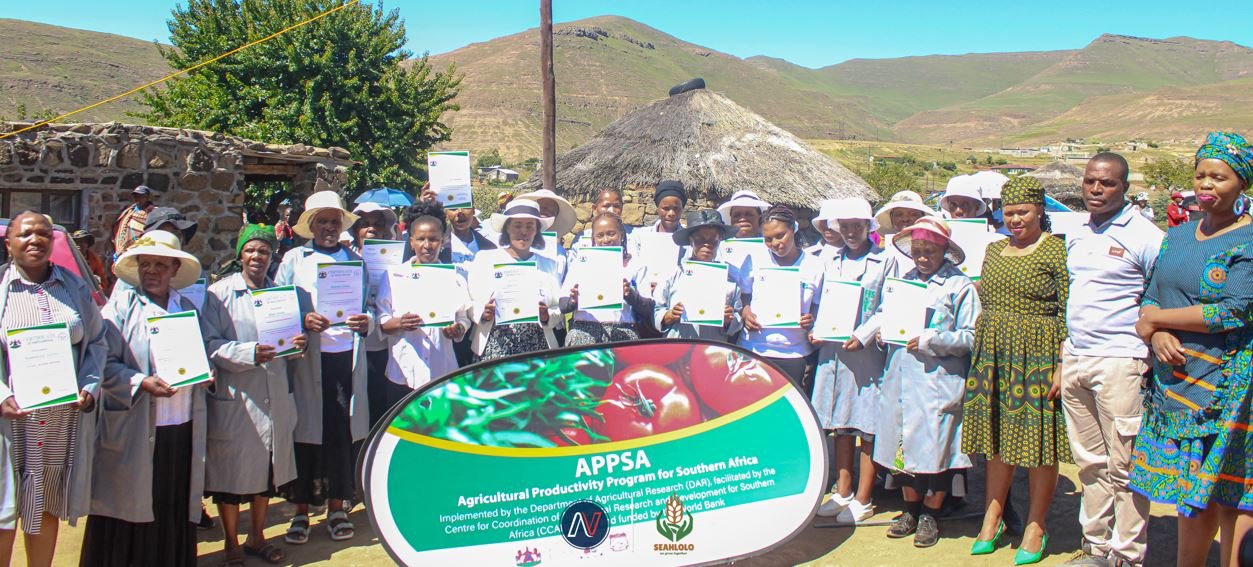

The Smallholder Agricultural Development Project II (SADP II), in collaboration with the Department of Agricultural Research under the Ministry of Agriculture, Food Security and Nutrition, has awarded certificates to 26 members of the Itjareng Farmers Field School in Mokhotlong after three years of training.
The graduation marked a significant milestone, highlighting the farmers’ journey of practical learning, knowledge-sharing, and skills development aimed at improving agricultural productivity.
Farmers’ Field Schools (FFS) were introduced in 2021 under the Agricultural Productivity Programme for Southern Africa (APPSA), through a sub-project focused on driving technology adoption and enhancing profitability through the dissemination of improved agricultural practices.
Guided by the principle of “learning by doing,” the Itjareng group underwent hands-on training in soil preparation, fertiliser and manure application, seed selection, pest management, harvesting, storage, and market access.
The celebratory mood among the graduates reflected the programme’s impact, with many farmers noting that the training has enabled them to make more informed decisions in their daily farming activities compared to before joining the initiative.
They expressed gratitude to APPSA, the Department of Agricultural Research, extension officers, local leadership, and the broader community for their support throughout the programme.
One of the graduates, Joalane Motlelehi, was overcome with emotion during the ceremony.
“I am finally holding my first school certificate. I cannot believe it,” she said.
Motlelehi recalled that, for three years, there were doubts within the community about the value of their work in the fields.
“All the early mornings have paid off. There were times I thought I would never graduate, but the extension officers supported me through difficult days. I am here because of their encouragement,” she said.
Declaring herself proudly as “a graduate of the Farmers Field School,” she added that the certificate symbolises perseverance and will inspire her children for years to come.
“This is not just a piece of paper. It is a testament to hard work and collaboration. I am a farmer, a mother, and a provider,” she said.
Another graduate, Mareneiloe Motlelehi, noted that the programme has strengthened unity within the village.
“We are now able to work together as a community. The lessons from the field school extend beyond the fields to our home gardens, where we now plant with clear planning,” she said.
The Itjareng Farmers Field School began with four demonstration plots, where farmers experimented with different soil treatments. Some plots used both manure and fertiliser, others used only one input, while one plot used neither, allowing farmers to observe differences in crop growth. Participants also conducted early morning field visits to monitor pest activity and crop development.
According to the Department of Agricultural Research, improving food production remains critical for Lesotho and the wider Southern African region.
For Lesotho to achieve its 2030 development targets, significant progress in the agricultural sector is essential. Farmers seeking to transition from subsistence to commercial farming are increasingly eager to adopt modern technologies and practices, positioning them as key drivers of national development.
A 2024 United Nations report on food security in Lesotho revealed that more than 699,000 Basotho are facing food insecurity, underscoring the urgent need for investment in sustainable agriculture and climate-resilient farming methods.
The Farmers Field School approach is equipping farmers with practical tools to respond to the challenges posed by climate change. Currently, Lesotho has eight such schools, with many farmers already benefiting from the programme.
This initiative offers hope for reducing the country’s reliance on food imports, particularly from South Africa, while contributing to the achievement of several Sustainable Development Goals (SDGs), including No Poverty, Zero Hunger, Good Health and Well-being, and Climate Action.
As the programme expands, more farmers are expected to benefit from modern, sustainable farming techniques. Success stories like those of the Itjareng graduates demonstrate the transformative potential of targeted training and support for smallholder farmers.
With continued backing from APPSA and other stakeholders, Lesotho’s agricultural sector is poised for growth, offering a pathway toward improved food security and sustainable development.
