





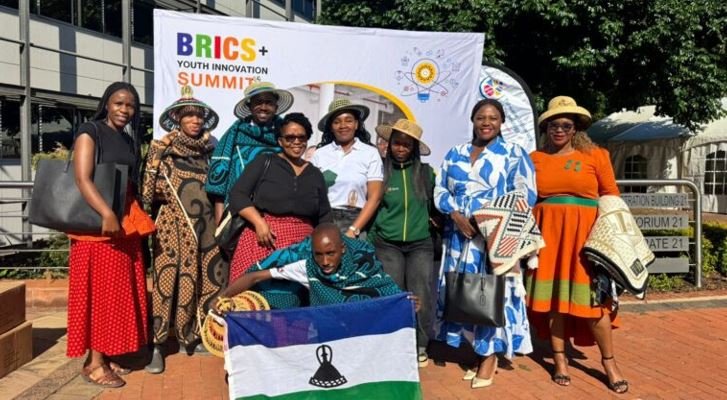

Lesotho’s emerging innovation landscape received both a reality check and a moment of recognition at the 4th BRICS+ Innovation Summit, where youth-led solutions from across developing economies competed on a global stage.
Although the country did not rank among the top-performing nations, a local climate-smart agriculture initiative secured a place among the top three, highlighting both the promise and the persistent gaps shaping Lesotho’s innovation ecosystem.
Held in Pretoria from 9 to 10 April, the summit brought together innovators, policymakers, and industry leaders from BRICS countries: Brazil, Russia, India, China, and South Africa, alongside partners from Africa, Asia, and Latin America.
The platform focused on youth-driven innovation, digital transformation and sustainable development.
Lesotho’s participation was facilitated through the Sebabatso initiative, which supports young innovators by creating opportunities for them to showcase their ideas on regional and international platforms.
Through this initiative, six Basotho youth presented solutions across sectors, including climate-smart agriculture and technology, gaining exposure to potential investors and collaborators while benchmarking their work against global standards.
The experience revealed both progress and limitations.
Pitso Lesaoana, Minister of Gender, Youth and Social Development, commended the participants while acknowledging the level of competition.
“We will continue to conduct roadshows across the country to encourage young people to showcase their ideas. Opportunities like this can open doors for innovation and growth,” he said.
He further emphasised the importance of strengthening both innovation and market readiness.
“Funding is not the problem. Partners such as UNDP and LNDC are available, but young people must refine their ideas and improve how they present them,” he added.
This gap between innovation and readiness was echoed by the participants themselves.
Rets’elisitsoe Mapara, who competed in the AgriTech category, pointed to limited industry exposure as a key disadvantage.
“Our competitors had more experience and exposure. That highlighted where we need to improve,” he said.
Mapara’s innovation focuses on improving vegetable production through more efficient transplantation methods, an approach aimed at increasing yields and reducing reliance on food imports.
“Going forward, we need to better understand the sector, what it needs and how we can serve farmers more effectively,” he added.
Despite the overall outcome, Lesotho made a significant mark through the success of Bashoeshoe Climate Smart Community Gardens, founded by Rererile Kamohi, which ranked among the top three innovations at the summit.
The initiative focuses on equipping smallholder farmers with climate-smart practices to address challenges such as drought, soil degradation, and unpredictable weather patterns. Through a community-based approach, it promotes water conservation, improved soil management, and diversified production systems.
Kamohi emphasised that the initiative is designed primarily for impact rather than profit.
“Bashoeshoe aims to address food insecurity. It is not a profit-driven project meant to benefit communities while generating data that helps improve how we support farmers,” she said.
However, scaling such innovations remains a challenge.
“To expand this across the country, we will need stronger partnerships and sustained funding,” she noted.
The summit ultimately underscored a critical reality for Lesotho: innovation exists, but scaling it into systems that reach farmers at a national level remains the missing link.
Participation in platforms such as BRICS+ offers valuable exposure and learning opportunities. However, without stronger support structures, ranging from access to funding and technical development to market integration, many promising ideas risk remaining small-scale.
As climate pressures intensify and food systems face increasing strain, the need to translate innovation into practical, scalable solutions becomes more urgent.
Lesotho’s performance at the summit may not have met expectations, but the recognition of a climate-smart initiative signals a clear direction: the country’s strength lies not in the absence of ideas, but in the need to better support, refine, and scale them.