



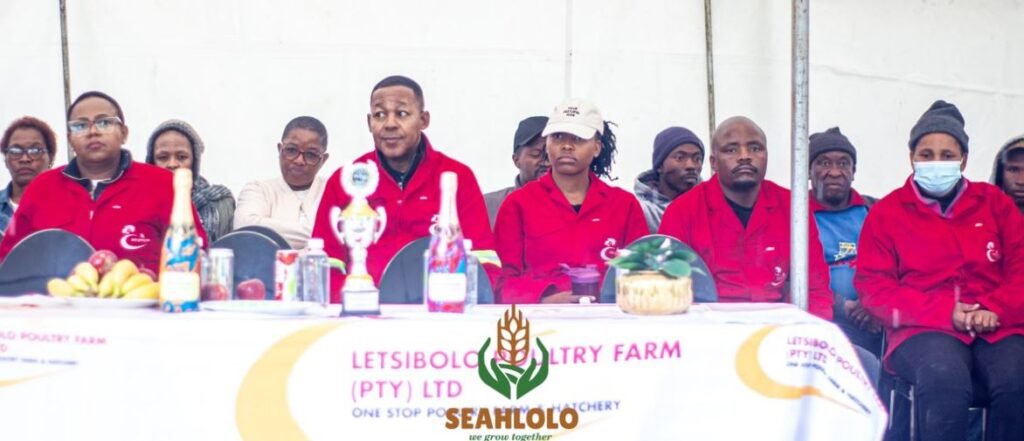
The rain arrived quietly, settling in a steady drizzle that might have discouraged a less determined crowd. Instead, farmers, officials and partners gathered under a white canvas tent, pulling their jackets tighter and leaning closer to one another, not out of discomfort, but out of shared purpose. There was a sense that what had brought them together at Letsibolo Enterprise’s field day was larger than the weather: a growing belief that Lesotho can and must begin to feed itself.
“The journey has not been an easy one, but how far Letsibolo has come shows the effort that has been put into the work,” said Sechaba Rakotsoana, a representative of the District Agricultural Office Maseru, setting the tone for a day that was as reflective as it was forward-looking.
Held on 24 April 2026 and hosted by the Smallholder Agriculture Development Project Phase II (SADP II) in partnership with the District Agricultural Office (DAO) Maseru and the Masianokeng Resource Centre, the field day gathering brought together a cross-section of the agricultural sector. Beneath the tent, conversations unfolded not in formal speeches alone, but in quiet exchanges among farmers, comparing notes, weighing possibilities, and imagining what scaling local production could look like in practice.
At the centre of it all was Letsibolo Poultry Farm & Hatchery, a Maseru-based agribusiness that has steadily carved out a place within Lesotho’s poultry value chain.
Established in 2016, the enterprise supplies day-old chicks, feed equipment, vaccines and technical training to farmers across the country. Over time, through investment in hatchery technology and improved breeding systems, it has evolved from a small operation into a growing support system for both smallholder and emerging commercial farmers.
Beyond production, the enterprise promotes poultry farming as a pathway to job creation, improved household income and food security, particularly in rural communities where access to reliable markets, inputs and technical support remains limited.
Poultry’s relatively low start-up costs and quick turnaround cycles have made it an increasingly attractive option, especially for youth and women seeking entry into agribusiness.
Rakotsoana acknowledged that the partnership between SADP II and Letsibolo and the progress came with challenges, but stressed that the field day was as much about revisiting the journey as it was about celebrating milestones. He urged the enterprise to take the next step by investing in local production of fertile eggs, citing Lesotho’s continued dependence on South African imports as a potential threat. Reducing this reliance, he said, would strengthen local value chains and protect farmers from external supply disruptions and rising costs.
Letsibolo Managing Director, Pitso Mokaeane, described the business as the product of persistence and gradual growth, shaped by both setbacks and strategic support. He acknowledged the role of founder Rethabile Mokaeane, who established the vision for the enterprise between 2015 and 2016 before handing over operations.
“It has been a long journey of hard work and learning. I had no understanding of this kind of business at first, but I had to continue building the vision as she did.”
“That vision was initially shaped by our founder, Rethabile Mokaeane, between 2015 and 2016, before leadership transitioned. The early years were marked by uncertainty with limited funding, unreliable supply chains and a small, unpredictable market. But a turning point came in 2019 when strategic partnerships began to take root.
“We then sought support from the Ministry of Agriculture and SADP II, which granted us M1.5 million. That support helped us move forward,” Mokaeane explained.
Since then, Letsibolo has expanded both its capacity and its reach. Through a project supported by the Food and Agriculture Organization (FAO), the enterprise supplied more than 27,000 chicks across Lesotho in just three months. In another intervention, SADP II procured approximately 70,000 chicks for distribution to youth entering poultry farming, an initiative that significantly extended Letsibolo’s footprint while opening doors for new entrants into the sector.
Still, growth has not eliminated vulnerability; the business continues to rely on imported fertile eggs from KwaZulu-Natal in South Africa, a process that introduces logistical challenges and biosecurity risks. Transporting eggs over long distances requires precision and care, reinforcing the urgency of building local capacity.
Mokaeane was candid about the broader pressures facing the enterprise. Policy shifts, dependence on imported inputs, seasonal production cycles, and the constant threat of disease all shape the operating environment.
These realities are not unique to Letsibolo but reflect structural challenges within Lesotho’s agricultural system, however, they also highlight where opportunity lies.
Makara Mpako, representing SADP II management, pointed to Letsibolo as evidence that targeted investment can yield tangible results.
“Letsibolo is part of SADP II Phase II and a beneficiary of our large grant programme. They successfully completed their project implementation on time and received certification. We are extremely proud of their achievements,” he said.
He expressed confidence that the enterprise could scale further, contributing to a more self-sufficient poultry sector and reducing the country’s reliance on imports.
For farmers on the ground, that impact is already visible. Thabo Leoatle, a poultry farmer, described how his business has grown through his partnership with Letsibolo.
“I started with 3,000 chicks from Letsibolo, and my customers have only had good things to say about the quality. I will continue working with them because they provide reliable and high-quality stock,” he said.
Consistency, he noted, has allowed him to build trust with customers, turning what began as a small operation into a more stable enterprise. He also emphasised the accessibility of Letsibolo’s services beyond Maseru.
“Letsibolo is a nationwide business, it is not only for people in Maseru. Anyone interested in poultry farming can work with them. They have proven the quality of their work, and that gives farmers confidence to grow,” he said.
As the programme drew to a close, the rain showed little sign of letting up. Yet few seemed eager to leave. Conversations stretched on, contacts were exchanged, and ideas began to take shape under the shelter of the tent.
What lingered was not just a sense of achievement, but of possibility.
