

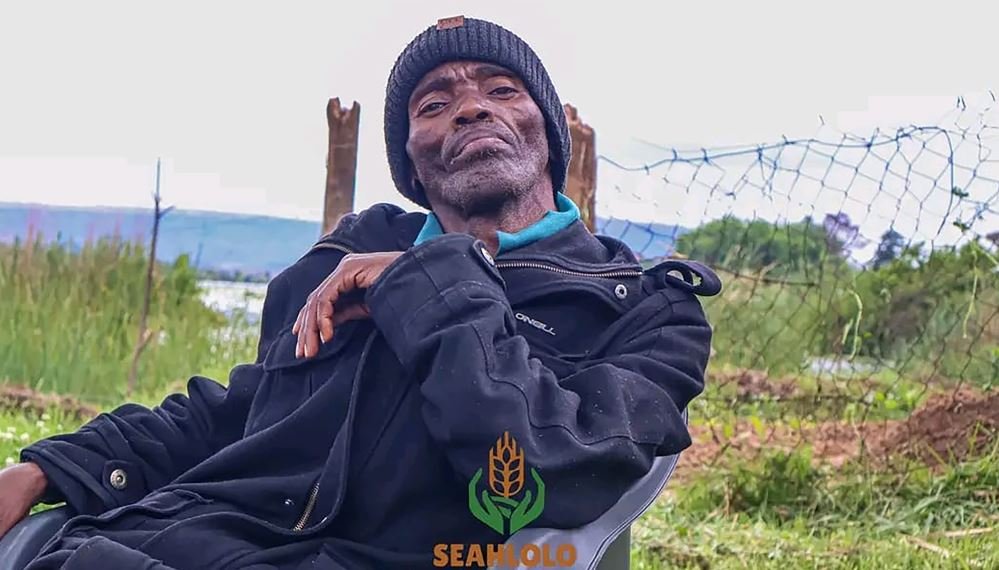

…Dr Samuel Molete’s Journey from Herding Livestock to Transforming Lesotho’s Agriculture
By Seahlolo Reporters
From the grazing fields of Quthing to agricultural studies beyond Lesotho’s borders, Dr Samuel Molete has built a life around knowledge, organic farming and regenerative agriculture. Living with a physical disability, he has turned his expertise towards empowering communities, developing agricultural products and sharing practical skills with thousands of Basotho.
Long before academic qualifications, international studies and agricultural training programmes became part of his life, Dr Molete was a young herd boy in the rural landscapes of Quthing, watching over his father’s livestock with agricultural magazines in his hands and questions about the world beyond his village occupying his mind.
The animals required his attention, but the pages of those magazines offered him something equally compelling: a glimpse into the science, possibilities and opportunities of agriculture.
A young man from a financially struggling rural family, university seemed a distant ambition. Yet, somewhere between the grazing fields and the agricultural knowledge he discovered through reading.
He began imagining a future in which farming would become more than the livelihood he had inherited.
It would become his profession, his intellectual pursuit and eventually, the means through which he sought to transform the lives of others.
Today, Molete is an agricultural practitioner and educator whose work spans organic farming, regenerative agriculture, food science, agro-processing and community training. Living with a physical disability, he has pursued an extensive educational journey and dedicated much of his professional life to helping rural communities acquire the knowledge and skills needed to improve their agricultural practices.
His story is not defined by the physical challenges he lives with, but by an extraordinary determination to learn, question, innovate and share what he knows.
His life is shaped by the knowledge he values most and his belief that the future of farming lies in understanding the relationship between healthy soils, natural resources, productive communities, and sustainable livelihoods.
“My experience on my father’s farm shaped the person I became; the more I was at the farm, the stronger the passion to farm became until I decided to study it,” Molete recalled.
His father’s farm was his first agricultural classroom.
There, he learned through observation and participation, caring for livestock and becoming familiar with the responsibilities of farming long before he encountered formal agricultural education.
Yet his curiosity extended beyond the work in front of him.
“While looking after animals, I would read agricultural magazines whenever I had the opportunity, and some magazines introduced me to new farming ideas and showed me possibilities beyond the life I knew,” he said.
“I would be looking after the animals while reading magazines, and I started asking myself how I could make it to university.”
Those questions would eventually lead him beyond Lesotho’s borders.
Although his family’s financial circumstances made further education difficult, Molete refused to abandon his ambition.
“I did not have everything I needed financially, but I had hope. I believed that education could open a different path for me,” he said.
His determination took him to South Africa, where he sought employment on farms while continuing to pursue opportunities to study agriculture.
The decision was driven by the need to earn a living, but it also let him stay connected to the field that had captured his imagination.
“Through hope, I went to South Africa, where I found work on farms. Both necessity and ambition drove my decision to cross the border as I was looking for a living. Still, I also wanted to remain close to agriculture and continue learning through practical experience,” he explained.
Working on commercial farms in South Africa exposed him to different production systems, agricultural technologies and approaches to farm management.
He observed how livestock and crops were managed, how farming enterprises operated and how practical knowledge could be strengthened through scientific understanding.
But Molete wanted more than farm experience.
“I was working on the farms, but I always knew that I wanted to study agriculture. I wanted to understand what I was doing and learn how I could improve it,” he said.
Unable to finance his studies independently, he approached commercial farmers for whom he worked and explained his ambition.
His commitment impressed them enough for some to help with his educational fees, enabling him to combine work with formal training.
“The farmers helped me because they could see that I was serious. I continued working while studying, and that was not easy, but I knew that the opportunity was important,” Molete said.
Between 2002 and 2005, he pursued agricultural studies in Cape Town, building on the knowledge he had gained through years of practical farming.
The classroom did not replace the lessons of the farm. It gave them scientific structure and deeper meaning.
“Because I had already worked on farms, I could relate my studies to real situations. I was not learning agriculture only from books; I had experienced it practically,” he explained.
Completing his studies marked an important personal milestone, bringing him closer to a dream that had once seemed beyond his reach.
“When I obtained my qualification, I felt that the dream I had while looking after animals had started becoming a reality,” he said.
But his academic ambitions did not end there.
Molete understood that agriculture was not confined to growing crops or raising livestock. He saw it as a field connected to technology, food science, manufacturing, business and the wider economy.
In 2008, he acquired computer skills and later participated in a six-month initiative supported by the United Nations Population Fund. After the initiative ended, he continued volunteering and gained further experience in community work.
Between 2011 and 2015, he studied food science and technology, broadening his understanding of how agricultural commodities could be processed and developed into consumer products.
He then studied marketing from 2015 to 2017, gaining knowledge of product development, packaging, consumer needs and commercial opportunities.
“My studies helped me see that agriculture does not end when a crop is harvested; there is also processing, product development, marketing and business,” he said.
His pursuit of knowledge continued in 2018, when he undertook further studies abroad specialising in organic agriculture and reportedly obtained a doctorate in the field.
The breadth of his education reflects a deliberate effort to understand agriculture as an interconnected system, from soil conditions and crop production to processing, enterprise development, and access to markets.
“I have always believed that learning should continue. Agriculture is connected to many other fields, so I wanted to understand those fields as well,” Molete said.
Yet the most significant aspect of his educational journey may be what he chose to do with the knowledge he acquired.
Rather than treating his qualifications as an individual achievement, Molete developed a commitment to transferring agricultural knowledge to communities that often have limited access to specialist training.
“I did not want education to remain something that only benefited me. I wanted to bring what I learned back home and share it with others,” he said.
Returning to Lesotho, he began applying his experience through agricultural training, organic production, agro-processing and product development.
His work has since taken him across all ten districts, where he trains communities in organic farming methods, preparing natural agricultural inputs, liquid fertiliser production, tree planting and regenerative farming practices.
At the heart of his approach is a belief that agriculture must work with the natural environment rather than exhaust the resources on which production depends.
“Regenerative agriculture seeks to improve the condition and functioning of agricultural ecosystems through practices that can support soil health, biodiversity, water management and long-term productivity. Organic farming, meanwhile, emphasises production systems that restrict or avoid certain synthetic agricultural inputs and use management practices designed to support ecological processes. These are not merely technical subjects to me. They reflect my broader conviction that agricultural development should protect natural resources while creating practical opportunities for communities,” he explained.
His interest in preparing natural fertilisers and other agricultural inputs reflects his commitment to helping farmers understand the resources available to them and how to use them responsibly.
“This knowledge I have can be particularly relevant to smallholder farmers seeking affordable and locally appropriate approaches to managing their production systems, although the effectiveness and safety of individual preparations depend on their composition and correct use.
Molete sees agricultural education as a way to help farmers make more informed decisions rather than depending entirely on outside expertise.
“I believe agriculture can give people skills, purpose and an opportunity to contribute, regardless of their background,” he said.
His work also extends beyond crop cultivation to the processing and development of agricultural products.
Through the Kingdom Herbs Grow project, representing Siyakhula Group, Molete has contributed to training in herb cultivation, plant care, harvesting and processing, including the production of herb-based spices.
The initiative reflects his interest in helping agricultural producers identify opportunities beyond selling raw commodities.
“Farmers must not only think about what they can grow, but they must also think about what they can make from what they grow,” he said.
This philosophy is central to his understanding of agricultural transformation.
“For rural communities, the ability to process agricultural products can create opportunities for diversification, additional income and participation in different stages of the value chain.”
Drawing on his studies in food science and technology, Molete has also developed products including cosmetics, cleaning supplies and juice.
“My product-development work explores how agricultural resources can be processed into finished goods for practical use,” he explained.
“I believe that agro-processing can help farmers and communities create additional income opportunities.”
According to an attendance register maintained during his training activities, Molete estimates that he has trained more than 53,000 people across Lesotho.
The figure reflects the scale of his outreach efforts, although it does not independently establish the number of unique individuals trained or the longer-term outcomes of their participation.
He however, charged that the significance of agricultural education lies not simply in how many people attend training sessions, but in whether the knowledge they acquire improves their circumstances.
“The number of people trained is important, but what matters most is whether the training makes a difference in their lives,” he said.
He wants agricultural knowledge to reach young people, rural communities and others who may not have the resources or opportunities to pursue formal training.
“I know what it means to dream of an education while lacking the money to pursue it. I understand the value of learning from practical experience and the importance of people who recognise potential and provide opportunities for others to develop it,” he said.
“We must help people understand that agriculture is an opportunity to learn, produce and innovate,” he said