



…Farmers Pitso Agriculture Week gave farming a national stage.
Twenty-seven schools took part. One hundred and eighteen farmers were recognised across 44 award categories. Ten Royal Honourees were celebrated.
Over four days, Farmers Pitso Agriculture Week filled the ’Manthabiseng Convention Centre with the people, ideas and work behind Lesotho’s food production. Organised by Seahlolo Newspaper under Newsday Media, the 2026 event brought together hundreds of participants from farming communities in Lesotho and South Africa.
Producers stood alongside young agro-processors, agricultural experts, organisations, businesses and high school learners.
Company branding, exhibition stalls and musical performances added colour and movement to the venue.
Agriculture was visible everywhere: in the products on display, the conversations between farmers and experts, the learners presenting their projects and the applause for award recipients.
The week combined practical knowledge sharing, student participation, public exhibition and recognition of agricultural excellence.

It gave farmers a place to discuss the obstacles they encounter in production and marketing, while allowing the public to celebrate the people whose work supports food security and rural livelihoods.
The first two days focused on the National Farmers Knowledge Exchange.
On day one, the conversation focused on livestock and poultry. Farmers and experts exchanged ideas on feed management, animal health and productivity, including the need for local feed production and stronger support for livestock farmers.
Opening the programme on behalf of Agriculture Minister Selibe Mochoboroane, Mabusetsa Makau urged participants to use the gathering to find practical solutions.
“This gathering came at an important moment for Lesotho, when the country continues to face food insecurity, climate variability, declining soil fertility, pressure on rangelands, limited access to finance and markets, and dependence on imported food,” he said.
Makau argued that farmers alone could not solve any of those challenges. “The challenges facing farming in Lesotho require farmers, researchers, development partners, businesses, financial institutions, media and communities to work together for improved value chains.”

He also recognised Seahlolo’s role in convening the sector. “I recognise Seahlolo Newspaper, Lesotho’s premium agricultural publication under Newsday Media, for taking the initiative to convene the agricultural sector through a national platform. It is encouraging to see a media institution moving beyond reporting on agriculture and actively creating space for farmers, experts, policymakers and agricultural institutions to share knowledge, confront challenges and identify practical solutions.”
For Makau, the platform’s value depended on keeping farmers central.
“Discussions about agriculture should not happen far from the people who work the land and carry the risks of production, and with Farmers’ Pitso 2026, all are included to be in one room.”
He called for reliable extension services, quality inputs, appropriate technology, affordable finance, effective insurance and access to markets, backed by policies that respond to the realities of production. He also appealed to development partners to see agriculture as an area for serious investment and lasting partnerships.

“Farmers, this platform exists because of you. Your knowledge, resilience and experience must guide today’s discussions,” Makau said before formally opening the programme.
On the second day, the Knowledge Exchange moved from livestock and poultry to grain and horticulture under the theme “From Field to the Market.”
Panel discussions followed the agricultural value chain beyond production. Speakers examined how farmers could improve post-harvest handling, reduce losses, aggregate produce, obtain finance and reach markets that offer sustainable returns. Better storage and technical support emerged as recurring needs.
Assistant FAO Representative and Head of Programme, Mokitinyane Nthimo, urged participants to assess whether investment supports national agricultural priorities.
“If livestock production is declared a priority, then farmers should not still depend heavily on imported fodder when they have land that could be used to produce it,” he said.
He added, “Most of the time we have normalised producing food for us, forgetting that animals also work hard in producing such food, so we need to choose our priorities wisely and stick to them. Animals should not eat leftovers.”
Nthimo questioned whether annual budgets reflect stated policy priorities and whether spending reaches farmers in useful ways.
“Agriculture discussions should move beyond statements of intent and focus on practical solutions that align policy, investment and implementation.”
The exchanges highlighted interventions farmers could feel on the ground: fodder production, extension services, irrigation and access to inputs. They also made clear that an agricultural budget’s success should be judged by what it enables producers to do, particularly as they contend with climate shocks and low productivity.

The third day brought a different kind of excitement to the convention centre.
The National Schools Agriculture Challenge drew 27 high schools, whose learners presented projects, competed in quizzes and explained agricultural ideas and innovations. They spoke about farming with the curiosity and confidence of young people being given a platform of their own. Their participation showed how schools can help students see agriculture as a field where they can create, solve problems, and build a future.
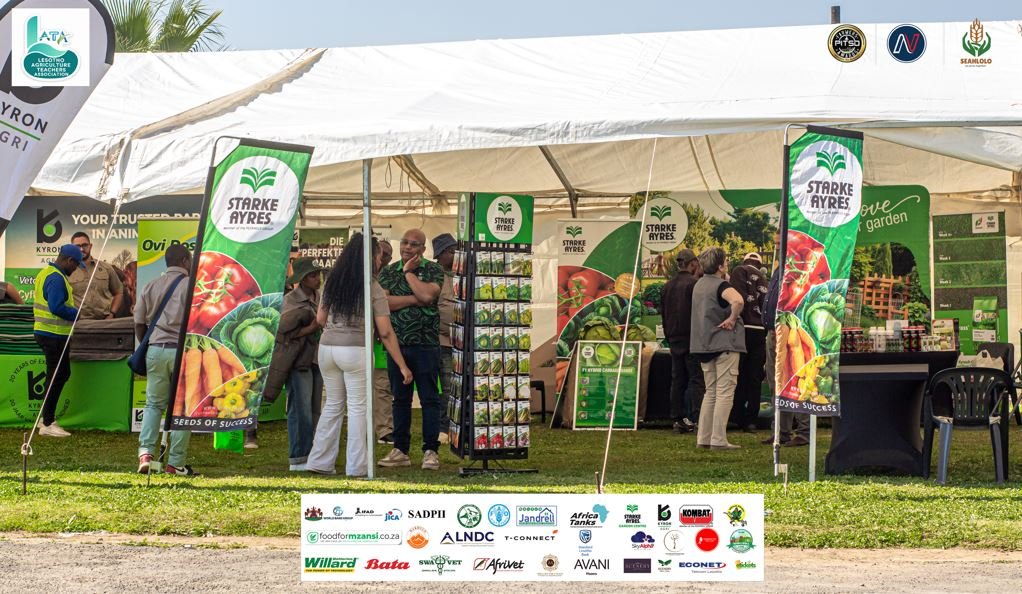
On the fourth day, exhibition stalls brought products, services and businesses into direct contact with farmers and visitors. The public could move between displays and conversations that showed how many people and enterprises contribute to agriculture beyond the farm itself. Musical performances added to the celebratory atmosphere as the week moved towards its awards ceremony.
There, 118 farmers were recognised across 44 categories covering work from livestock and crop production to agribusiness. The awards placed producers in the spotlight and acknowledged achievements that can otherwise pass with little public notice, despite their importance to food production and community resilience.
The celebrations concluded with a gala dinner attended by His Majesty King Letsie III. Ten Royal Honourees were celebrated for their contributions to agriculture and rural development, bringing the four-day programme to a close with recognition of service and lasting impact.
Minister Mochoboroane used the gathering to stress that raising food production requires more than farmers’ commitment. Knowledge and skills, he said, must be shared widely and applied to the conditions of individual farms.
“Many farmers in Lesotho struggle not because they lack commitment, but because they lack proper training and practical guidance,” he said.
The minister suggested that training even 300 farmers could have a wider effect if they returned to their villages and passed what they had learned on to others. He also called for experts to work directly with farmers in their fields, where advice could respond to the land, crops and challenges in front of them.
“Lesotho used to perform strongly in farming because the soil was naturally fertile, but today the land needs better methods, improved inputs and more careful management. Working directly with farmers would help them make better decisions on seed selection, fertiliser use, crop care and harvesting,” he said.
Mochoboroane also cautioned that mechanisation requires planning and proper support. “Agricultural growth depends on practical support, knowledge transfer and solutions rooted in the realities of the farm.”
Farmers’ Pitso began in 2012 as a training session intended to equip farmers with basic skills. Awards were introduced in 2018 to celebrate excellence. Over the years, the initiative became a place for farmers to connect and showcase their work. In 2026, it grew from a one-day event into four days that brought learning, schools, exhibitions and recognition together.
Applause for farmers was part of what made the week a success. Another was the sight of the wider agricultural community gathered around them: experts sharing knowledge, learners testing ideas, businesses presenting opportunities and institutions being asked to turn their commitments into practical support. Farmers’ Pitso Agriculture Week gave agriculture a national stage. Its next achievement will be measured by how far the knowledge, connections and momentum travel beyond it.