


Introduces EcoFarmer AI, a mobile agricultural tool to help farmer understand soil conditions ahead of planning farm operations.
A field may look uniform from one end to the other. Beneath the surface, however, moisture and acidity can vary, differences that matter when a farmer decides what to plant, how much fertiliser to apply and when to irrigate.
At the Farmers Pitso Agriculture Week National Farmers Knowledge Exchange, Econet Telecom Lesotho brought those decisions into focus.
Its representatives from Econet Wireless Zimbabwe presented agricultural technologies designed to help producers understand their fields and get timely advice on their mobile phones.
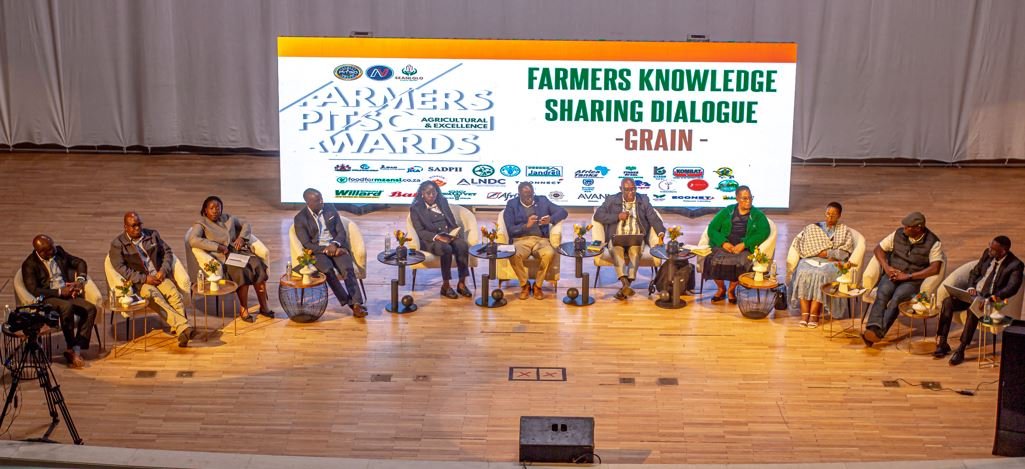
The grain-production session paired technology with discussions of soil health, seed quality and water.
For farmers facing unpredictable rainfall, rising input costs and disappointing harvests, the presentation explored how better information could strengthen the experience and hard work already invested in production.
Central to that conversation was EcoFarmer AI, an artificial intelligence-powered agricultural platform developed by Econet Wireless Zimbabwe.
The company representatives describes it as a service providing guidance on crops, livestock and weather, with location-based weather updates, voice and text questions, and the ability to upload photographs of crop problems. Its published App description identifies English and Shona as supported languages, with development of Sesotho in its final stages.
The technology specialist, Ignatious Chitekedza, argued that agriculture must adapt as new tools become available.
“Our grandparents started farming in the Stone Age, moved to the Iron Age, then to the Computer Age, and now we are in the Artificial Intelligence Age. We must use this age to strengthen agricultural productivity and resilience,” he said.
Chitekedza explained that farmers may assume an entire field has the same soil conditions and apply identical quantities of fertiliser and water throughout, yet conditions can differ even within a relatively small area.
“One might assume that a small piece of land has the same quality, but in reality, pH levels are different, and moisture levels too can differ, so, we need a solution to determine where the moisture and pH differ before proceeding with working the land.”
He described soil sensors as one way of gathering information that cannot readily be seen from the surface.
“These sensors can be placed in the soil to gather information on moisture levels, pH, and other factors that affect crop growth.”
The resulting data, he said, could help farmers and agricultural specialists make more targeted decisions.
“Those sensors can generate data that we can analyse and tell us that at point A of the field, the pH is different, and determine how we need to apply a certain amount of fertilisers and irrigation,” Chitekedza said.
Econet’s wider agricultural technology offering includes a separate precision-agriculture sensor solution for monitoring soil moisture, crop health and environmental conditions. The company also offers weather intelligence and farm-management tools, placing EcoFarmer AI within a broader range of digital agricultural services.
For grain farmers, Chitekedza said, collecting information helps them use resources more efficiently and improve crop performance.
“When farmers practice farming without technology, the yield often becomes poor, but aligning with technology can increase the yields,” he said
He also discussed monitoring approaches that could help farmers judge when irrigation is needed, including methods that do not require sensors in every section of a field.
“In some sections, sensors are not even needed to tell a farmer when to irrigate, what quantity to use, and to detect problems early,” he said.
Chitekedza’s presentation considered the potential for technology to flag crop problems before they spread.
“There are sensors that determine diseases, like the IoT sensors can determine plant health as well as diseases at an early stage.”
He added that information about soil conditions could guide crop selection, helping farmers assess whether their preferred crop suits the land available.
“Sometimes a farmer is passionate about producing a certain grain, but the soil does not allow it. With technology, we can help farmers to know which crop is suitable in a certain field depending on the type of soil.”
The discussion then moved from understanding the field to obtaining advice. Moderator, Maoala Khesa, asked how agricultural innovation could improve soil preparation and post-harvest grain management.
Kundayi Faith Mazonda, speaking on agricultural innovation, presented EcoFarmer AI as a way to bring guidance closer to farmers who may struggle to reach an extension officer or agronomist when they need assistance.
“As Econet, we are actively closing the gap in agriculture. With our product, Eco-Farm AI, we have transformed every phone into an intelligent advisor, providing farmers with real-time agronomy advice.”
Mazonda said farmers could use the platform to access farming calendars, weather information, and crop-management guidance to support decisions from land preparation through harvesting.
“Farmers can easily access any required agronomical information through their devices with Eco-Farm AI,” she said.
The Zimbabwe launch offers further context for the service presented at Farmers’ Pitso. According to launch coverage published by TechnoMag, the platform was unveiled under Econet AI and uses farm coordinates to generate localised weather information, soil insights and crop-specific guidance. The report says its weather projections extend up to 100 days; this is a reported platform capability, not a demonstrated guarantee of forecast accuracy.
Speaking at that launch, Econet AI Chief Executive Officer Navdeep Kapur said: “EcoFarmer AI also helps farmers understand soil conditions and apply the right inputs at the right time.”
The launch coverage described the aim as helping farmers plan planting, irrigation, and harvesting using information specific to their farms. Kapur also outlined an ambition to double productivity through better decisions throughout the farming cycle.
At the Manthabiseng Convention Centre, Mazonda demonstrated the relevance of another feature: using photos to get guidance on crop problems.
“The application’s visual intelligence allows a farmer to take a photo of a crop, and the AI will advise on implementable practices to prevent challenges,” she said.
For a producer observing discoloured leaves, pest damage or unfamiliar symptoms, such a feature could offer an initial route to information. Mazonda said the platform also seeks to tailor its advice to the farmer’s circumstances.
“It localises information, offering precise advice on weather suitability and what actions a farmer should take,” she said.
Language was another part of the discussion. Advice must be understandable if farmers are to use it.
“I am pleased to say the App also uses local languages, bridging the information gap to address literacy issues,” Mazonda said.
She described the App accessibility through USSD services for basic mobile phones, alongside voice features, and explained that connectivity requirements vary between functions.
“Some modules can be accessed even when offline, but for specific features, an internet connection is fully needed,” she said.
Mazonda also presented a marketplace component of the App intended to connect producers with agricultural suppliers and service providers. The purpose, she explained, is to help farmers move from obtaining advice to finding the inputs and support needed to act on it.
“The App also has a marketplace that brings various players together in one application.
“Service providers are available for crop chemicals, irrigation, and more, while customers ready to purchase ready products can also be reached.”
Her central message was that information could help farmers make decisions more precisely.
“Through technology, we are able to transform agriculture from a game of chance, where people are assuming, to being precise,” Mazonda said.
Econet’s contribution reflected the wider purpose of Farmers Pitso Agriculture Week National Farmers Knowledge Exchange of bringing producers into conversation with experts, businesses and institutions offering approaches to agricultural challenges.