

Founder, Seahlolo Newspaper; Managing Director and Managing Editor, Newsday Media
Some projects you deliver; others change how you understand the work.
Farmers Pitso Agriculture Week 2026 did both.
Across four days, 27 schools participated, 118 farmers were recognised across 44 award categories, and 10 Royal Honourees were celebrated. Those figures tell part of our achievement. The fuller story, however, lies in the people who came together and what their encounters made possible.
I came away convinced that Lesotho has people who care deeply about agriculture. We met farmers determined to improve, experts willing to share knowledge, businesses prepared to participate, and young people curious about their place in the sector.
Our task was to connect that commitment.
Agriculture cannot grow in silos.
A farmer’s work is shaped by decisions and services far beyond the farm gate. Research influences production methods. Water and infrastructure determine what can be grown and preserved. Finance affects whether an enterprise can invest. Buyers influence quality requirements and planting decisions. Public policy shapes the conditions in which all of this happens.
When these parts work separately, farmers are often left trying to bridge the gaps.
That is why, as organisers through Newsday Media’s Seahlolo Newspaper, we expanded the Farmers Pitso Awards into a programme that connects knowledge exchange, schools, exhibition, and recognition.
We wanted farmers to meet people who could help them address practical challenges. We also wanted those institutions and businesses to hear directly from producers.
A scientist should understand what happens when advice reaches a farm with limited resources. A financial institution should hear why an agricultural enterprise struggles to meet funding conditions. A buyer should explain what it requires. Government should hear how communities experience services. A learner should be able to see a future in agriculture.
The National Farmers Knowledge Exchange created space for those conversations. Across livestock, poultry, grain and horticulture, speakers returned to the connections between knowledge and practice.
Soil testing matters, but farmers need access to the service and help interpreting the results. Better genetics matter, but animals also need appropriate nutrition and veterinary care. A good harvest matters, but handling, storage and a dependable buyer determine how much value reaches the farmer.
Putting those issues together was one of the most important things we achieved. It showed why agricultural development needs coordinated support.
The Ministry of Agriculture, Food Security and Nutrition, under Honourable Selibe Mochoboroane, deserves recognition for its support. The ministry’s endorsement helped bring institutions into the platform, while the minister’s emphasis on practical knowledge, appropriate mechanisation and stronger market connections reinforced the purpose of our expanded programme.
His call to bring knowledge to farmers in their communities is one we must carry forward. A useful lesson shared in Maseru should live beyond the venue. It should reach the field, the village and the producer who could not attend.
That responsibility also belongs to us as a publication. This issue of Seahlolo is part of the work of carrying the conversation forward: explaining what was shared, recording farmers’ experiences, and identifying questions that still need answers.
The farmers gave the event and platform its meaning. They brought their time, stories, criticism and trust. They spoke about what they needed: knowledge, markets, practical support, and partnerships. Their participation reminded us how much responsibility comes with convening a national gathering in their name.
We must respect that trust by being honest about what an event can achieve. The Agriculture Week created opportunities to learn and connect. Whether those opportunities become stronger enterprises depends on what follows.
Our private-sector partners helped make the programme possible and showed how businesses can support that ongoing work.
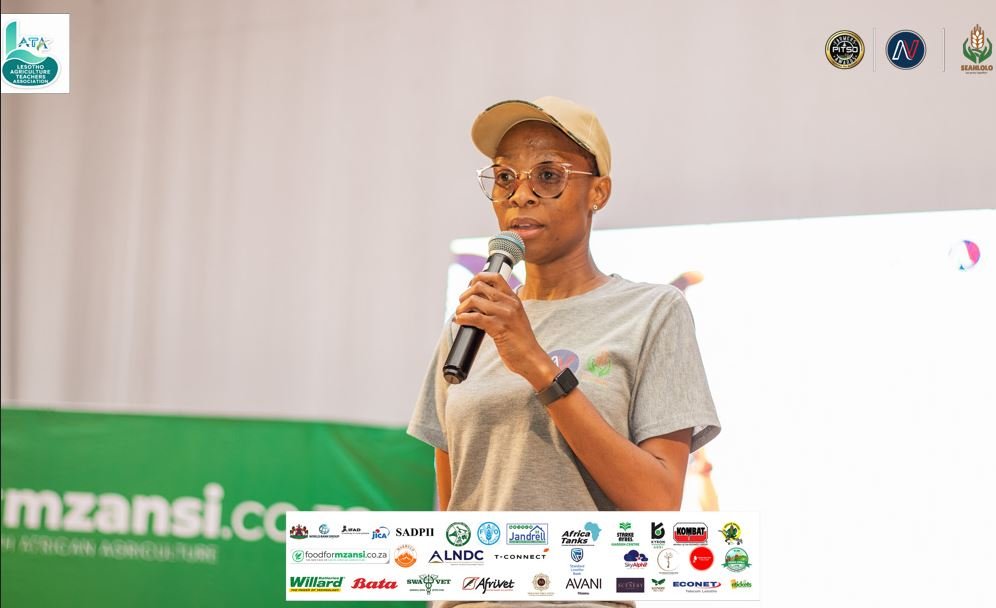
Jandrell Stores brought South African brands like Africa Tanks, Afrivet, SWAVET, STARKE AYRES, Bata, Willard, KOMBAT, KYRON and Mealie Brand into the gathering. Together, those brands represented products and services connected with agricultural production and rural enterprise, linking South African Service provision and Lesotho’s Agricultural development.
Ntate JC brought advanced drone technology from South Africa to share what our neighbours are doing to progress.
Their participation helped make the value chain visible. Farmers need infrastructure, animal-health support, inputs, equipment and services. Companies supplying those needs also benefit from understanding the farmers who use their products.
There is room to deepen these relationships. Businesses can contribute technical knowledge, distribution, technology, finance, infrastructure and market connections. They can help producers understand products, plan investments and solve operational problems.
For corporates in Lesotho, agricultural partnership offers an opportunity to build lasting commercial relationships while strengthening production. A farmer who develops a viable enterprise can become a reliable customer, supplier and employer. That is why we stay engaged throughout the year; we thank our sponsors and partners for adding value.
His Majesty King Letsie III and the Royal Palace gave the week’s conclusion significance, for which we are deeply grateful. His Majesty’s participation affirmed the importance of the people sustaining Lesotho’s food system.
The 10 Royal Honourees brought different forms of service into view: rural development, agricultural heritage, fresh produce markets, nutrition, veterinary care, culinary heritage, community empowerment, conservation agriculture, poultry and commercial horticulture.
Their recognition showed the breadth of contribution behind the food on our tables. It also reminded us that excellence can be built over a lifetime, through work whose value is felt quietly in communities long before it receives public applause.
Our gratitude extends to Food for Mzansi. Their team brought specialist agricultural journalism experience and helped equip local media professionals to report the sector more effectively. Their coverage also carried Lesotho’s agricultural stories to a wider Southern African audience.
That matters because how agriculture is reported shapes how it is understood.
Farmers are entrepreneurs, employers, innovators and custodians of land. Their experiences belong in reporting about climate, trade, technology, finance, nutrition and economic development. Journalists need the knowledge to explain those connections and the independence to examine whether promises and programmes are delivering.
The media training was therefore part of Agriculture Week’s purpose. Useful agricultural knowledge needs people who can communicate it accurately and consistently.
The schools’ challenge carried another part of that purpose. Twenty-seven schools brought learners’ knowledge and practical work onto a national stage. We wanted young people to see agriculture as a field in which they could build skills, businesses and careers.
That interest deserves continued encouragement. Learners need opportunities to practise, meet professionals and understand how classroom knowledge connects with real enterprises. Their participation gave us reason to invest further in that work.
I am particularly grateful to my team. Behind every visible moment were conversations, adjustments and problems that participants never saw. Expanding the programme meant undertaking activities we had not delivered in this form before.
We kept asking what the platform could offer: practical learning for farmers, stronger connections for businesses, a place for learners, better reporting and recognition worthy of the people receiving it. My team carried those questions into the work.
Most times they looked at me like a madwoman, saying what we wanted to achieve was suicidal, but we survived and came out victorious.
We should also learn from what needs improvement. Clearer communication, stronger coordination and reliable follow-up will make the next programme better. Celebrating our achievement gives us the confidence to examine those responsibilities openly.
The next stage requires specific action. Institutions should identify how they will share knowledge beyond the event. Businesses should stay in touch with the producers they met. Researchers should make findings accessible. Farmers’ organisations should help carry information through their networks.
As organisers and journalists, we must also keep asking what became of those connections. Which advice was applied? Which opportunities developed? What prevented progress? What support is still missing?
Lesotho has experience to contribute to wider conversations about resilient food systems and agricultural enterprise. Our farmers know the challenges of producing here. Our researchers are examining local questions. Our young people bring ideas and energy. Connecting those strengths can help us develop approaches suited to our circumstances.
Farmers Pitso Agriculture Week gave us a place to begin that work together. We are proud of what we delivered, and grateful to everyone who helped us deliver it.
Now we must keep the relationships active and the knowledge moving. Agriculture belongs at the centre of our discussions about livelihoods, nutrition, employment and national development.
The week showed how much becomes possible when people meet across their usual boundaries. Building on it will require the same willingness to listen, cooperate and act.
Agriculture cannot grow in silos. Neither can a nation.