

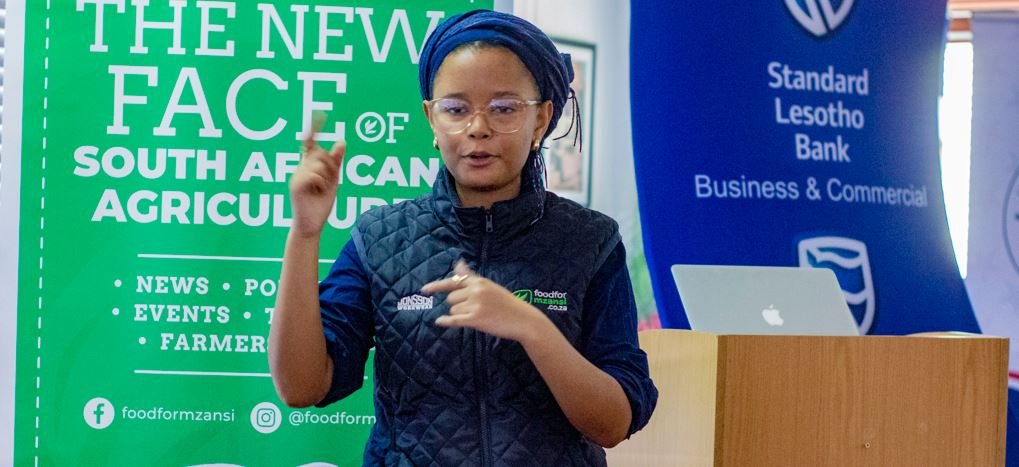

Twenty media professionals joined training on agricultural reporting, audience engagement and digital security as part of Farmers Pitso Agriculture Week.
The knowledge shared during Farmers Pitso Agriculture Week needed to go beyond the conference room. Farmers who could not attend, communities facing production challenges, and audiences trying to understand Lesotho’s food system also needed access to accurate, useful information.
That purpose shaped a specialised agricultural journalism training hosted by Seahlolo Newspaper during the week. Twenty media professionals participated in sessions led by South Africa’s Food for Mzansi, alongside cybersecurity training delivered by T-Connect.
The programme connected agricultural knowledge with the people responsible for explaining it to the public. Participants explored how to report across the food value chain, build stronger relationships with audiences and protect their work and sources in an increasingly digital environment.
For Seahlolo founder and Newsday Media Managing Director, Lerato Matheka, the training formed part of Agriculture Week’s wider ambition to connect farmers with knowledge, institutions and opportunity.
“Farmers Pitso Agriculture Week was designed to bring the agricultural value chain together, and journalists are a part of that chain because they help knowledge travel beyond the venue to farmers and communities who were not in the room,” Matheka said.
“We want agricultural reporting that follows the farmer from production to the market, explains the science, examines the policies and asks whether support is reaching the people who need it. Agriculture deserves informed, consistent coverage throughout the year.”
Opening the training, Food for Mzansi news editor and agricultural journalist, Tiisetso Manoko, challenged the idea that agriculture belongs at the margins of news coverage.
“Agricultural journalism is often treated as a niche beat, but agriculture impacts almost every aspect of society.”
“If you ate today, thank a farmer who produces food. As journalists, farmers know about new developments in agriculture through us, so we have to be very accurate and professional in our storytelling,” he said.
His message placed responsibility alongside opportunity: ‘Reporting can introduce farmers to new developments, but inaccurate or poorly explained information can leave audiences confused about decisions affecting their livelihoods.’
Manoko urged participants to look beyond announcing events and describing activities, saying a useful agricultural story should explain causes, consequences, and the people affected.
“As agricultural journalists, our role is to inform by presenting facts, not emotions. We do not just report what happened in the farming sector; we help readers understand what happened, why it happened, who is affected, and why it matters.”
That approach requires reporters to understand the subject they are covering.
“Agriculture reporters must understand agriculture before reporting on it because it encompasses more than just farming; it includes food security, markets, climate change, animal health, policy, research, and community livelihoods,” he said.
The breadth of that coverage reflected the conversations taking place across Farmers Pitso Agriculture Week.
“Production, nutrition, research, finance, technology and markets are connected. A problem in one part of the system can affect farmers and consumers elsewhere.”
Manoko also emphasised journalism’s role in scrutinising agricultural policies, budgets and programmes.
“As reporters, we are the mouthpiece of the masses, the voice of the voiceless; thus, agricultural journalism is public interest journalism because it affects all of us, and people eat every day.”
He encouraged participants to build stories around multiple perspectives, bringing farmers’ experience into conversation with evidence and institutional responses.
“A story with only one voice is not a journalism article; we need at least three sources: a farmer providing lived experiences, a researcher offering evidence and technical interpretation, and the government providing policies, programs, and official data.”
The sourcing discussion also covered businesses that can explain commercial conditions and markets, development organisations working on agricultural programmes, and communities, farmworkers, and labour unions whose knowledge adds context to a story.
For freelance journalist and farmer Thandiwe Kubere, the training exposed the limitations of covering agriculture mainly when something goes wrong, or a new product arrives.
“Reporting agricultural news, for most of us, is something we do only during breaking events like disease outbreaks or the arrival of new equipment. This training has been incredibly insightful,” Kubere said.
Mathe Maboee, a journalist working in the agricultural information department, raised a different difficulty: securing publication for sensitive stories within a government institution.
“As a journalist in a government institution, even if I cover a story on affected communities, such stories are often not considered worthy by editors and are not published, as editors prioritise their own preferences,” Maboee said.
Manoko encouraged reporters to discuss their story ideas with editors and explain their public importance.
“As a journalist, it’s important to discuss your story’s worthiness with editors and explain why it deserves publication.”
The training then turned from producing stories to ensuring they reach the people who need them.
Food for Mzansi social media manager, Meshaan Van Wyk, described community engagement as central to agricultural publishing. Farmers, agronomists, suppliers and policymakers, she said, need information that is practical, timely and trusted.
“Community engagement is the cornerstone of editorial credibility,” she said.
“Media houses engaging with social media audiences transform a media organisation from a distant publisher into a vital industry partner.”
Van Wyk encouraged participants to use formats suited to their audiences, including short videos, practical discussions, newsletters, WhatsApp channels and infographics. The aim was to make reporting easier to access and encourage interaction around issues that affect producers.
“Firstly, a media house can host a practical discussion on a current regional challenge, allowing viewers to interact easily,” she said.
She also urged media organisations to make newsletters useful in their own right.
“Avoid simply dropping article links into emails. Instead, provide digestible market digests, personalise content by sector, and maintain a conversational tone.”
Longer reporting, she explained, can be adapted into several formats to extend its reach, support website and app audiences, and strengthen newsletters and messaging services. A detailed story can become the starting point for a short video, a visual explanation or a conversation with readers.
T-Connect’s Keiso Mohloboli completed the programme with a session on cybersecurity, highlighting the risks of digital journalism.
The session addressed device security, verification, source protection and the steps journalists should take when responding to an incident. Mohloboli outlined a sequence of practical actions: know the device, lock it, verify information, protect sources, and prepare to respond, recover, restore and document what happened.
The discussion recognised that journalists continue to face censorship and physical threats while also encountering risks to their accounts, communications and unpublished material. Digital security therefore belongs within newsroom practice and professional training.
Mohloboli encouraged participants to consider Signal for sensitive communications and to take a more deliberate approach to the tools they use.
“As cyber threats to journalism grow more sophisticated, the need for tailored cybersecurity solutions has become more pressing than ever,” Mohloboli said.
Together, the sessions linked reporting quality, audience access and journalist safety. Each matters if agricultural information is to reach communities consistently and retain their trust.
The training also strengthened cooperation between agricultural media organisations in Lesotho and South Africa. Food for Mzansi’s participation gave local journalists a chance to learn from another newsroom’s experience and explore approaches they could adapt for their own audiences.
For Seahlolo, that exchange extended the purpose of Farmers Pitso Agriculture Week. Farmers had a platform to share challenges and achievements; journalists had an opportunity to improve how they reported those experiences.