

Through productive gardens, poultry and piggery operations, the Leribe-based institution is showing how agricultural investment can strengthen food security, vocational education, and economic opportunities for learners with disabilities. But shortages of production inputs and limited financial resources threaten to hold back a model with potential for wider adoption.
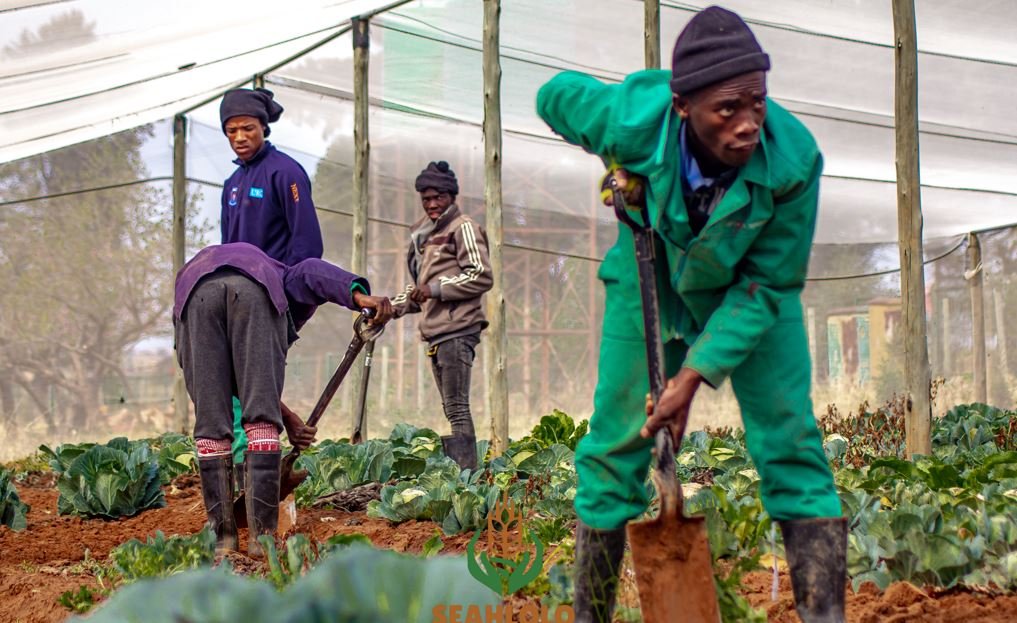
LERIBE — The metallic clinking of gardening tools, the gentle splashing of water from watering cans and the rhythmic movement of hoes breaking through the soil create a lively atmosphere in the gardens of St Paul’s School for the Deaf.
Amid the activity, young hands move between tending crops and communicating through sign language. Instructions are exchanged, questions answered, and responsibilities shared in a conversation that flows without spoken words.
Here, agriculture speaks a language of its own.
Behind the school’s existence lies a remarkable agricultural initiative that is transforming how learners with disabilities acquire practical skills, while helping one of Lesotho’s specialised educational institutions work towards greater food security and financial sustainability.
Agriculture has evolved beyond a conventional school gardening project into an integrated production and vocational training programme, combining vegetable cultivation, maize production, poultry farming and piggery operations.
The school is demonstrating how agricultural production can serve two important development objectives: improving access to food within educational institutions, and equipping young people with disabilities with skills that could enable them to participate in the agricultural economy, and its potential is evident in the productive infrastructure already established.
Active Learners gain practical experience, while former students have progressed into agricultural activities beyond the school grounds; however, shortages of farming inputs, financial constraints and livestock theft continue to undermine efforts to expand production and strengthen the institution’s long-term sustainability.
Farming as a classroom of opportunity
At the centre of the school’s agricultural programme is farm manager Motlalentoa Tsepane, who has developed a structured approach to teaching learners different aspects of agricultural production.
Under his supervision, farming follows a timetable that rotates learners between crop cultivation, poultry management and piggery operations.
“We have a timetable we use to do all farm activities, if one is taking care of chickens today, the following will be in piggery or crops,” Tsepane explained, noting the arrangement is designed to ensure that learners acquire knowledge across different agricultural enterprises rather than becoming familiar with only one activity.
The timetable, Tsepane noted, also gives agricultural training the structure and recognition associated with conventional classroom learning.
“Learners follow designated working periods and breaks, while their participation is assessed according to individual abilities, interests and progress.”
He explained that the objective is to establish agriculture as a meaningful educational pathway rather than an activity assigned to learners who experience difficulties with academic subjects.
“Just like in a traditional classroom, on the farm, I am able to notice each student’s capabilities and weaknesses, and we work towards each other’s weaknesses to reach the same goal of a productive farm,” he said, stressing that the approach reflects the school’s recognition that academic performance alone does not determine a learner’s potential.
“ For children whose educational experiences may be affected by communication barriers or additional learning needs, practical agricultural training offers opportunities to demonstrate abilities that conventional examinations may not adequately capture.”
Tsepane said working with deaf learners initially presented challenges, particularly in ensuring effective communication during activities that require careful coordination and attention to safety.
“Farming itself is hard work; it needs a lot of patience and responsibility, but for my students, it’s a way to use hands and mind together. To avoid harmful setbacks, I always make sure they face each other while they work. They are a group with different disabilities beyond not hearing. Others have both mental disabilities, so when they work facing each other, they understand that one is a keeper of the other,” he explained.
The importance of visual communication is evident in the way learners interact during agricultural activities.
“By ensuring that that tactic, learners can see one another when instructions are being communicated.”
Tsepane said he has adapted ordinary farming practices to suit his students’ needs without compromising the responsibilities associated with agricultural production.
He said the experience has become increasingly rewarding as learners develop confidence, demonstrate responsibility and improve their ability to undertake agricultural tasks.
“Our goal is to recognise that academic performance should not define a student’s potential. We cater for difference, and we believe every child has unique talents,” he said.
Tsepane’s programme is currently training its second group of learners under his supervision. At the same time, efforts are being made to follow up with former participants to see whether they continue practising agriculture after leaving school.
An agricultural investment feeding both learners and ambitions
St Paul’s agricultural development has been supported by The Ivory Foundation, which began assisting the institution in 2015 through the establishment of a pilot farm on the school grounds.
The partnership was designed around two complementary objectives: improving the school’s capacity to produce food for its boarding learners and equipping students with agricultural knowledge that could support their livelihoods after graduation.
Over the years, the initiative has developed into a diversified agricultural programme involving crop and livestock production.
The school has established vegetable gardens, shade-net cultivation facilities, poultry operations and a piggery, providing opportunities for learners to participate in different stages of agricultural production.
The farm contributes vegetables and other agricultural produce towards the school’s food requirements, reducing some of the pressure associated with feeding learners who reside at the institution.
For a boarding school operating under financial constraints, this contribution is significant.
“ Food purchases represent a recurring operational expense, but our agricultural production offers an opportunity to reduce dependence on external suppliers while providing learners with practical experience,” he said, adding that the programme also introduces students to the relationship between agricultural inputs, labour, productivity and the economic value of farm produce.
“ Rather than learning about agriculture exclusively through textbooks, learners participate in planting, maintaining crops, feeding livestock and understanding the responsibilities involved in managing productive agricultural enterprises.”
The Ivory Foundation’s involvement has also supported the development of educational gardening activities for younger learners.
In 2021, the Palesa Garden was established as a learning space divided into four sections, allowing different classes to take responsibility for vegetable plots.
The initiative incorporates learning materials adapted for sign-language communication, connecting agricultural knowledge with accessible teaching methods.
“Through these activities, agriculture becomes part of the learning experience from an early stage, while older learners are gradually introduced to more demanding production responsibilities, and the result is an educational model in which agricultural production and skills development reinforce one another,” Tsepane described.
Beyond school: cultivating independent livelihoods
Tsepane further revealed that through support from The Ivory Foundation, former learners have participated in Farming Our Future, an initiative intended to help young people continue developing their agricultural skills after completing their education.
“The initiative initially operated an agricultural site at St Monica before expanding through the acquisition of three hectares of land at Levi’s Nek.
“The development represents an important step in addressing the transition from vocational education to economic participation for young people with disabilities, because for many learners leaving specialised educational institutions, opportunities for employment and independent livelihoods can be constrained by limited access to skills development, finance and supportive working environments.
“Agriculture offers one possible pathway towards addressing these challenges, particularly where young people can access land, production inputs, technical guidance and markets,” Tsepane asserted, charging that the progression from school-based agricultural training to farming activities undertaken by former learners demonstrates the potential of vocational education to support economic participation beyond the classroom.
“Education is not only about acquiring academic qualifications, but also about preparing children for adulthood, independence and participation in their communities, and here at St Paul, agricultural training provides a foundation upon which learners may develop household food-production activities, pursue agricultural employment or establish small farming enterprises.”
However, he indicated that the ability to translate these skills into sustainable livelihoods depends on the availability of continued support after graduation.
“Access to agricultural finance, land, extension services and markets remains important in determining whether trained young people can successfully enter the agricultural economy, and the school’s experience therefore presents an opportunity to examine how agricultural entrepreneurship programmes can better accommodate young people with disabilities.”
Despite its achievements, Tsepana noted that St Paul continues to face challenges that threaten the sustainability of its agricultural operations.
Principal Mapotlai Rakoti revealed that the school struggles to meet the educational, nutritional and residential needs of its learners while also facing insufficient financial resources.
Although farming has helped the institution strengthen its food-production capacity, Rakoti has stressed that the availability of agricultural inputs remains a major concern.
Rakoti said delays in securing fertilisers and seeds have disrupted the school’s maize-production plans, affecting both anticipated harvests and income-generation opportunities.
“If we always got subsidies on time, we could have already planted maize. Previously we cultivated our land on time, and by January we used to sell maize and got cash for other school needs, but now we are faced with the prolonged waiting for inputs and our financial plans keep falling off,” she said.
Her concern highlights the importance of timely agricultural support for institutions whose production activities depend on seasonal planting cycles.
“Unlike some other development activities, crop production cannot always be postponed without consequences. Delays in obtaining seeds and fertilisers can result in missed planting windows, reduced yields, and lost opportunities to generate revenue, and these disruptions affect more than our agricultural output.
“The school’s farming activities are closely connected to our ability to supplement food supplies and generate resources that can support other institutional needs.”
Rakoti explained that a successful maize harvest, for example, can contribute to the school budget through sales, while production failures can increase pressure on already limited financial resources.
“The school’s agricultural operations have also suffered losses associated with livestock theft.”
Tsepane said the institution previously ran cattle and rabbit enterprises, but discontinued them after theft-related losses.
“The setbacks illustrate the vulnerability of agricultural projects operating without adequate resources to protect productive assets, and for an institution that has already invested in farming infrastructure and practical training, the challenge is not simply establishing new agricultural activities, but protecting and strengthening what has already been developed,” Tsepane stressed, saying the school faces a difficult balance between its ambition to expand agricultural production and the financial resources required to sustain existing operations.
A local initiative reflecting Africa’s agricultural ambitions
The agricultural programme at St Paul’s reflects a broader international recognition that food security, education and economic inclusion are interconnected development priorities.
The United Nations Sustainable Development Goals establish commitments to ending hunger, improving access to quality education, promoting decent work and reducing inequalities.
These objectives are reflected in Sustainable Development Goals 2, 4, 8 and 10, which collectively recognise the importance of food production, inclusive learning opportunities, productive employment and the participation of marginalised groups in economic development, and at St Paul, these priorities converge within a single agricultural programme.
The school produces food to supplement its nutritional requirements while providing practical training intended to strengthen learners’ prospects for economic participation.
Its experience also reflects the aspirations of the African Union’s Agenda 2063, which identifies modern agriculture, education, skills development, and inclusive economic growth as foundations of Africa’s long-term development.
The continental framework envisions an Africa in which agricultural transformation contributes to prosperity, food security and improved livelihoods.
These priorities have been reinforced through the African Union’s Kampala Declaration on the Comprehensive Africa Agriculture Development Programme, adopted in January 2025.
The declaration and its accompanying strategy for 2026 to 2035 seek to accelerate the transformation of African agrifood systems through increased investment, higher agricultural productivity, improved food security and stronger economic opportunities.
The strategy includes continental ambitions to increase agrifood output and mobilise greater public and private investment in agricultural development.
Although these commitments target national and continental agricultural systems, institutions such as St Paul demonstrate how investment in agriculture can contribute to several development outcomes at once.
The Food and Agriculture Organization of the United Nations also recognises the importance of connecting schools, nutrition education and food systems, including through approaches that strengthen agricultural knowledge and access to nutritious food, and St Paul provides a practical example of how these objectives can be pursued within a specialised educational environment.
Its farming programme contributes to food production while equipping learners with skills that may support their participation in agriculture beyond school.
The institution’s experience also illustrates why disability inclusion must be considered within agricultural development planning.
The United Nations Convention on the Rights of Persons with Disabilities recognises the rights of persons with disabilities to education, vocational training and employment opportunities.
Changing perceptions through production
Principal Rakoti said the agricultural programme challenges perceptions about the capabilities of people with disabilities and demonstrates the importance of providing opportunities that recognise individual strengths.
“Too often, society views disability through a lens of limitation, but we are showing that people with disabilities can excel in farming with the right support. This project isn’t just about agriculture and food production but an intentional initiative aimed at changing mindsets and breaking down barriers,” she said.
“Alongside agriculture, the institution offers other vocational activities, including tailoring, recognising that learners possess different interests and abilities.”
Tsepane, for his part, believes educational systems should accommodate these differences and create pathways through which young people can develop skills suited to their capabilities.
“Education must be flexible and student-centred,” he said.
“We advocate for systems that allow students to choose pathways where they can thrive, whether academic or vocational, and here that philosophy is being translated into agricultural activities that demand responsibility, patience, cooperation and practical knowledge.”