




…For generations, they have protected the nation’s livestock in silence. But when given the chance to speak, Ha Seeiso’s herders revealed that the heaviest burden they carry is not always on their backs but in their minds.
“People think herding is only about watching animals, but in reality it is a job that takes a lot from your mind.”
When Lempe Cheeke finally spoke, the room fell silent.
For years, he had spent his days walking mountains, watching sheep and cattle, measuring changing weather, protecting animals that did not belong to him and carrying responsibilities that few people ever stop to consider. Yet the greatest burden he described was not the physical demands of the job.
It was loneliness.
It was constant pressure.
It was living with the knowledge that one missing animal could cost him his livelihood.
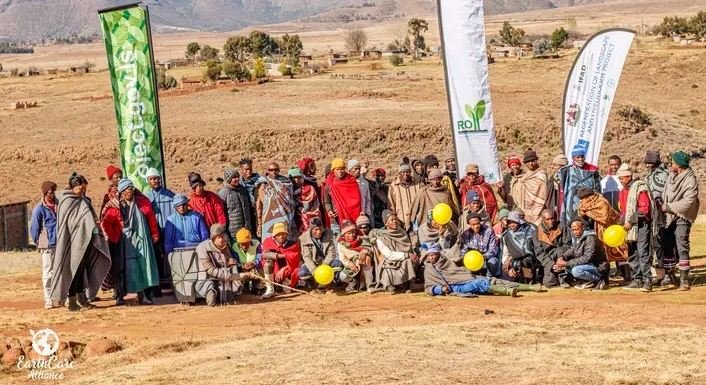
Around him, dozens of herders from inside the hall of Ha Seeiso nodded in agreement.
The gathering at Ha Seeiso in Thaba-Bosiu, in Maseru district, had been organised as a mental health awareness campaign by EarthCare Alliance, a local NGO, but it quickly became something much deeper.
Men who are often expected to endure hardship without complaint found themselves speaking openly about stress, fear, rejection, exhaustion and the emotional cost of a profession that remains one of the least understood in agriculture.
For perhaps the first time, the conversation was not about livestock. It was about the people who care for them.
Livestock remains one of the pillars of Lesotho’s agricultural economy.
Thousands of rural households depend on cattle, sheep and goats for income, food security and cultural identity. The country’s internationally recognised wool and mohair industries rely on healthy flocks, while livestock continues to provide financial security for countless farming families.
Yet behind every healthy herd stands a herder whose contribution is often overlooked.
Long before sunrise, they leave villages for distant grazing lands. They spend long hours exposed to harsh weather, monitor sick animals, protect livestock from predators and thieves and carry the responsibility of returning every animal safely to the kraal.
Despite the importance of their work, many say they remain largely invisible.
“They classify us as tools,” said Lebohang Matsie.
“They give us decayed food. They do not allow their own children to participate in agricultural work because they say that is why they hired us.”
He paused before describing a reality many other herders quietly acknowledged.
“Some tell you that as a herder you should stay at the kraal and never enter the house. Yet we are key players in producing food for those same families.”
For Matsie, the emotional burden often comes not from the mountains but from the way society treats the people who work there.
“It is hard to approach an employer about poor treatment because sometimes speaking up means losing your job.”
Alone with responsibility, Carrying blame that is not always yours
Many people see a herder walking across the mountains wrapped in a blanket and carrying a stick.
Few consider what occupies his mind.
“As a herder, you are always thinking about the animals, the weather, your safety and your family,” Cheeke said.
“Sometimes you are out there alone for many hours, and that loneliness becomes difficult to carry.”
Unlike many occupations, herding offers few opportunities to share daily frustrations with colleagues or supervisors.
The mountains are often quiet.
The work is solitary.
Yet every decision carries consequences.
“You can look after someone’s livestock from morning until evening, and when something happens, the first thing you hear is blame,” Cheeke said.
“People forget that we also get tired, we also get hungry, and we also get hurt by words.”
The appreciation, he said, rarely matches the responsibility.
“Sometimes the person who hires you is the same person who never thanks you, even when you have done your best.
Seabata Phohleli’s greatest source of stress is the fear of failing someone else’s expectations.
“When animals become sick or when one goes missing, it affects us deeply,” he said.
“I ask myself whether I did enough, whether I failed the herd, whether I will go home with bad news.”
He believes many employers underestimate the realities herders face.
“There are farmers who expect us to perform miracles. If one animal is missing, they speak as if we have committed a crime, even when the weather was bad, or thieves were around.”
Those words, he said, stay with herders long after the conversation has ended.
“In different fields and pastures, animals are not the only ones that suffer. The herders suffer too.”
Growing up before your time
Now 27 years old, Khotso Rasekoala’s entire understanding of manhood was shaped by the hardships of herding animals.
“For some of us who started herding at a young age, people expect us to become men immediately because we can take care of animals.”
The expectation, he says, leaves little room for vulnerability.
“Herders are seen as people who should not complain, should not cry and should not talk about being tired. It is not just a boy’s job. It tests our hearts, our patience and our minds.”
During the session, Rasekoala discovered that others shared many of the struggles he had carried alone.
“I am grateful to be here with people who do the same work. Hearing that we all face similar challenges has helped me to cope and realise I am not alone.”
He smiled before adding quietly, “If a herder says they are tired, society says you are weak. That is why many of us keep quiet.”
When silence becomes the greatest burden
Tlotlisang Molise believes that silence has become one of the biggest challenges facing men working in agriculture.
“Sometimes a herder may look strong outside, but inside he is tired, confused or discouraged. We are taught not to show weakness, but that teaching has hurt many of us.”
He also pointed to another pressure rarely discussed: the changing environmental conditions have made herding increasingly difficult.
“When pastures become dry, and animals lose weight, people blame the herder without understanding the real causes.”
Climate change, degraded grazing land and declining pasture quality continue to place additional pressure on those responsible for caring for livestock.
“We are the people taking care of the environment,” Molise said, “but decisions are often made by people who do not work where we work, and when conflicts arise, the consequences affect us.”
A room that finally found its voice
As the discussions continued, something remarkable happened.
The room changed. The guarded expressions softened. Shoulders relaxed.
Some men lowered their heads as they listened. Others nodded quietly.
A few wiped away tears.
What had begun as a mental health awareness campaign gradually became a space where hurt-shells of years of unspoken scars cracked.
Many admitted they had never before spoken openly about the emotional demands of herding.
For social workers Libuseng Malitsi and Tsoarelo Phakanyane, that willingness to speak represented an important first step.
“People think herding is only about watching animals, but in reality it is a job that takes a lot from your mind.”
“We have heard different situations that challenge your work as herders, and we have concluded that you already understand what stress is,” Phakanyane said.
He described stress as mental tension that develops when people feel overwhelmed by situations beyond their ability to cope.
Malitsi encouraged the men not to carry those burdens alone.
“When people keep their problems inside, the load grows. We want herders to know that speaking out is not a sign of failure but a sign that you are taking your wellbeing seriously,” she said.
She reminded the herders that difficult emotions deserve attention before they become something more serious.
“We are not here to tell herders that work will become easy. We are here to remind them that they should never face pressure alone. Talking to someone is often the first step toward healing.”
The social workers encouraged the herders to develop healthy ways of coping with stress, including talking to trusted friends, singing, gardening, writing, seeking counselling and building stronger community support networks.
More than a mental Awareness Campaign
Organising the gathering was not easy, Earthcare Alliance co-founder Malefane Maqele said, noting many herders feared taking time away from work because they worried about how employers might respond.
“Our core people are full-time workers, and the fact that they came here shows they wanted to be heard. Some attended despite fears that employers might question their absence, while others made arrangements to ensure livestock would still be cared for while they participated.
By the end of the day, Maqele believed something important had changed.
“We saw people who now feel empowered, seen, heard and appreciated.”