





Animal feed prices, which account for the largest share of production costs in Lesotho’s livestock sector, began to stabilise and modestly decline around June 2025, providing short-term relief to poultry, piggery and dairy farmers who had faced prolonged cost pressures.
Throughout much of 2024 and early 2025, rising feed prices eroded profit margins, compelling many livestock farmers to reduce production or exit the sector entirely.
Although the mid-2025 adjustment offered temporary respite, farmers and analysts caution that underlying structural challenges continue to jeopardise the sector’s long-term sustainability.
Lesotho’s livestock industry remains heavily reliant on South Africa for essential feed ingredients such as maize and soya.
Value chain assessments by the Lesotho National Farmers Union (LENAFU) indicate that limited domestic grain production and processing capacity necessitate the importation of most feed raw materials, rendering local prices highly sensitive to fluctuations in regional markets.
Consequently, feed prices in Lesotho closely mirror trends in South African grain markets.
When prices rise across the border, local farmers feel the effects almost immediately.
Price declines are often delayed by transport costs, logistics, and exchange rate fluctuations.
Regional agricultural market analyses reveal that grain prices in Southern Africa began to ease in mid-2025, driven by improved harvest expectations, particularly for yellow maize. This shift coincided with the period during which local feed suppliers reported price reductions.
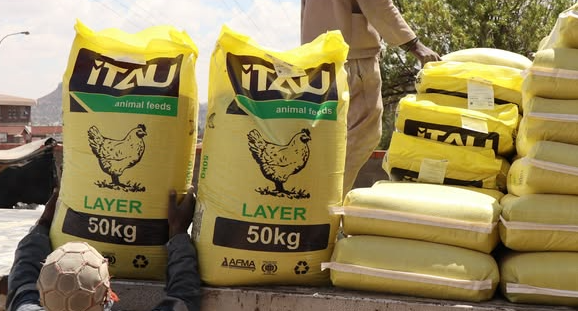
Rose Mary Raphoko of EW Farm Feeds confirmed that feed prices fell around mid-2025, primarily due to lower prices from South African suppliers such as Itau, from whom the company sources the majority of its feed.
“We still depend on South Africa because we do not yet have Itau operations locally, and our prices are strongly influenced by the Souh African operations,” she stated.
Raphoko noted that the reduction increased demand, with some farmers returning as customers and others purchasing feed for resale.
Industry analysts attribute the price moderation to improved grain availability, reduced supply constraints and relative stabilisation in regional commodity markets following years of climate-related shocks and supply chain disruptions.
Government intervention also contributed, with the Ministry of Agriculture and Food Security extending a livestock feed subsidy programme in 2024 to alleviate rising costs for farmers.
Rethabile Makhalema, founder of Makhalema Poultry Farm, remarked that the price reduction made it easier to maintain proper feeding levels, enhancing bird health and customer satisfaction. While the change did not significantly alter flock sizes, she said it helped stabilise cash flow.
Across the sector, poultry farmers welcomed the relief, noting that feed constitutes over 60 per cent of production costs. However, they emphasised that other inputs, such as day-old chicks, electricity, labour and veterinary services, continue to rise.
Dairy and pig farmers echoed similar concerns, stating that although easing feed prices prevented further losses, profitability has not fully recovered.
Despite the decline, feed prices remain significantly above pre-pandemic levels. Transport costs, fuel price volatility, and exchange rate fluctuations continue to offset the benefits of lower grain input costs.
LENAFU Programme Manager Khotso Lepheana has confirmed a price decline in 2025, noting that even modest reductions can significantly benefit farmers. He emphasised the importance of bolstering domestic grain production to decrease reliance on imports and enhance price predictability.
“When prices change unexpectedly, farmers struggle to plan,” Lepheana stated, adding that the lack of structured communication between feed suppliers and farmers exacerbates uncertainty.
Livestock farming is crucial to rural livelihoods and employment, and sharp increases in feed prices often result in job losses. Women and youth farmers are particularly at risk, as they usually manage smaller enterprises with limited financial buffers. Although the price decline in mid-2025 may slow farm closures, it has not reversed the broader trend of sector consolidation.
Feed prices directly impact the cost of animal-source foods, including eggs, poultry, milk, and pork. Rising production costs are passed on to consumers, leading to higher food prices and reduced access to affordable protein, particularly for low-income households.
While Lesotho has local feed mills, LENAFU noted that the reliance on imported raw materials leaves farmers vulnerable to regional price fluctuations. Sector stakeholders argue that achieving long-term stability will require coordinated investment in domestic grain production, improved logistics, targeted support for farmers, and stronger cooperatives.