











…as Lesotho Faces Growing Food Security Threat
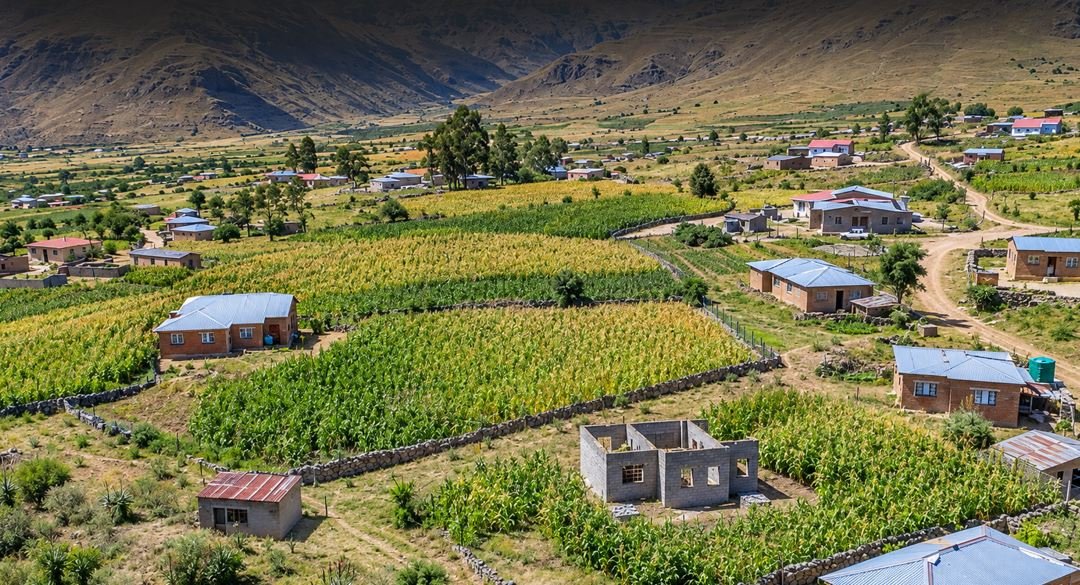
Lesotho’s limited agricultural land is coming under increasing pressure from residential developments, prompting the Senate to demand urgent government intervention to prevent the continued disappearance of productive fields and protect the country’s long-term food security.
The warning comes as Minister of Agriculture, Food Security and Nutrition Selibe Mochoboroane reveals that Lesotho has approximately 48,000 hectares of arable land, a figure he believes has declined further due to competing land uses and other pressures on agricultural resources.
For a mountainous country already confronting food insecurity and dependence on imported agricultural commodities, Mochoboronane said the conversion of fertile fields into residential settlements raises serious concerns about the future of domestic food production.
The Senate is now calling for stricter enforcement of the Land Act of 2010, a comprehensive national land audit, the reversal of unlawful allocations and more sustainable settlement planning to prevent further encroachment on agricultural land.
The debate followed a motion introduced by Senator Michael Maama and seconded by Senator Peete Lesaoana Peete, urging the government to take decisive measures against the conversion of agricultural land to residential and other non-agricultural uses.
Opening the debate, Senate Vice-President Tsukutlane Au outlined four measures proposed by the House to strengthen the protection of agricultural land.
“The Senate urges the Government of Lesotho to strictly enforce the Land Act of 2010 to ensure that any change of land use is authorised by the central office of the minister responsible for land matters, through the Commissioner of Lands, and is consistent with town and country planning objectives,” Au said.
The Senate further called for a comprehensive national land audit to determine the extent of agricultural land lost through unregulated sales, unlawful allocations, environmental degradation and residential encroachment.
Such an exercise, Au said, would help establish the scale of land conversion, identify areas requiring protection and provide a foundation for future agricultural land-use planning.
The House also urged the government to identify, review and reverse unlawful allocations and conversions of high-potential agricultural land, particularly where residential developments have proceeded without the necessary authorisation.
To meet growing demand for housing without sacrificing productive fields, senators proposed promoting higher-density settlements, including multi-storey residential developments.
The proposals reflect mounting concern that the expansion of towns and villages is taking place at the expense of land that could otherwise support crop production, agricultural investment and rural livelihoods, Senator Pontso Mathealira, Principal Chief of Tsikoane, Peka and Kolobere, said.
Mathealira warned that the continued loss of agricultural land could have serious consequences for Lesotho’s future food availability.
“When we talk about agricultural land, we are referring to areas where new homes are emerging, and villages are expanding. I call on everyone responsible to act and prevent this,” Mathealira said
She argued that protecting productive fields requires effective enforcement of existing legislation and greater involvement of technical authorities in decisions about changes in land use.
Referring to Section 42 of the Land Act of 2010, Mathealira said the Commissioner of Lands, the minister responsible for land matters and relevant technical experts should be involved in determining whether agricultural land may be converted to other uses.
She called for agricultural extension officers to play a more active role in advising communities and ensuring that land-use decisions consider the importance of maintaining productive farmland.
“I appreciate that the Ministry of Agriculture is present today. Basotho need supervision from extension officers so that clear procedures can be followed,” she said.
Mathealira also proposed expanding block farming arrangements, particularly in areas where elderly landowners hold agricultural fields but may no longer be actively engaged in cultivation.
Such arrangements, she said, could provide opportunities to bring underutilised fields into coordinated production while preserving their agricultural purpose.
Her concern extended to the contradiction between Lesotho’s national commitment to improving nutrition and the continued disappearance of land needed to produce food.
“It is discouraging to see His Majesty serving as a nutrition champion while Lesotho’s agricultural land is being lost every day,” she said.
His Majesty King Letsie III serves as African Union Champion for Nutrition and Food Security, advocating for stronger food systems, improved nutrition and increased investment in agriculture.
Mathealira also raised concerns about developments in Leribe, where she said farmers had previously been directed to move away from roadside fields before environmental authorities classified the area as a wetland.
According to her account, houses were subsequently constructed in the same area despite concerns raised by community members.
“Can the law be applied in such situations?” she asked.
The example raised questions about coordination between authorities responsible for agriculture, environmental protection, physical planning and land administration.
Senator ‘Mako Mohale, Principal Chief of Tajane, similarly questioned weaknesses in the administration and allocation of land.
He referred to land administration reforms associated with the Land Act of 2010 and the Millennium Challenge Account Compact I, supported by the United States government, arguing that clearer zoning should have been established to distinguish agricultural land from areas intended for housing, cemeteries, businesses and other developments.
“Field owners and agents allocate most land in this country, and these transactions are not properly regulated,” Mohale said.
He urged responsible institutions to strengthen oversight and prevent land transactions that undermine planned agricultural and residential development.
Senator Joel Motsoene, Principal Chief of Leribe, echoed the concerns, drawing attention to traditional settlement patterns that sought to preserve productive land.
“Our parents used to build houses on the foothills and cultivate the lowlands and flat areas, but now everyone wants to live in the lowlands near towns, and arable land is being affected,” Motsoene said noting that changing settlement preferences and growing demand for land near urban centres are placing additional pressure on fertile agricultural areas.
Motsoene questioned why existing legal provisions were not being implemented effectively.
“The law is clear. What is difficult about implementation? Let us obey the law and ensure that it is enforced,” he charged.
The debate also exposed concerns about accountability among institutions and individuals involved in land administration.
Senator Seabata Motsamai argued that the problem could not be attributed solely to government officials, saying political leaders, traditional authorities and other stakeholders had also failed to provide adequate oversight.
“The problem is in our thinking; the law is there, but implementation requires political will. We gave people power, and now we are here blaming them, yet we failed to work together and monitor the progress,” Motsamai said.
He alleged that some farmers, councillors and land agents were involved in corrupt land dealings, calling for stronger intervention by the ministries responsible for agriculture and local government.
Motsamai further warned that unresolved land disputes had become a serious concern in communities, sometimes resulting in violence.
“As a country, we have 76 councils, and there are many unresolved land disputes in each of them. Some Basotho have even killed one another over land,” he said.
He called for greater accountability, enforcement and monitoring to ensure that land administration serves the interests of communities and the country’s development priorities.
“Let us not fight the law. Let us implement it and ensure that progress is monitored,” Motsamai said.
Responding to the debate, Minister Mochoboroane welcomed the Senate’s intervention, saying it had opened an important avenue for strengthening government efforts to protect agricultural land.
He acknowledged the relevance of the Land Husbandry Act of 1979 and the Land Act of 2010, while emphasising the need to assess whether existing legislation adequately responds to present-day land-use pressures.
“I appreciate the debate that has taken place. I also acknowledge the Land Husbandry Act of 1979 and the Land Act of 2010. Through these laws, the ministry has identified room to align its work with existing legislation. However, we must also review whether the laws remain relevant to the realities of 2026, while recognising the importance of agricultural land.”
“Lesotho has about 48,000 hectares of arable land, and we can predict that this figure has declined because of several factors,” he said, noting the estimate illustrates the limited extent of land available for crop cultivation in a country where mountainous terrain already constrains agricultural expansion.
He stresses that the continued conversion of productive fields into residential plots presents a long-term challenge, “…particularly because land covered by permanent buildings and infrastructure cannot readily be restored to agricultural production.”
Mochoboroane said the unauthorised conversion of agricultural land contravened existing legal requirements and emphasised the need to consult the relevant government institutions.
“It is a violation of the law to use agricultural land for other purposes without consulting the Ministry of Agriculture, agricultural research departments and local government authorities,” he said.
He identified Manonyane, Seate, Qoaling, Hleoheng, Kanana, Berea, urban Mafeteng, urban Maputsoe, Mazenod and Mohalalitoe among areas experiencing significant pressure on agricultural land.
The locations demonstrate that the challenge is not confined to the capital, but extends to several developing settlements and agricultural areas across the country.
The minister said the Ministry of Agriculture hoped to undertake a nationwide land assessment during the next financial year, subject to funding availability.
“The exercise will help establish the condition and extent of agricultural land and provide information to guide protection measures, planning and future investment. The ministry will provide technical land-use information and advise authorities responsible for land planning and gazetting.”
Mochoboroane said the Ministries of Agriculture and Local Government had agreed to cooperate on immediate interventions while developing longer-term measures to address the continued conversion of farmland.
However, he emphasised that implementing these measures would depend on adequate financial resources.
“If we receive the required budget, protection of farming land will be a priority. The Senate should also resolve, as it will be the body monitoring our progress.”