

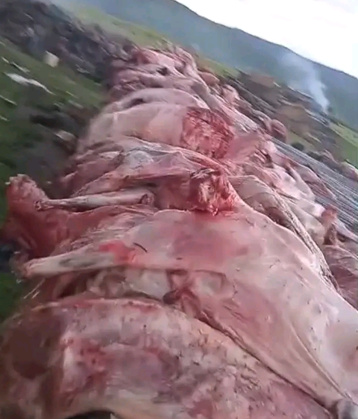

For Lekoko Salemane Hoko, a wool and mohair farmer with a flock of over 900 sheep, farming has always been an act of faith. Last month, that faith was brutally tested on a cold afternoon in Semonkong’s Ha Elia, when a sudden hailstorm killed 197 sheep within minutes as they were being driven home from a wool shearing centre.
“The day started normally, like any other shearing day, filled with satisfaction and a job well done. We collected clean wool and hoped for a handsome income,” Hoko recalled, noting that the morning passed smoothly.
On that day, he worked closely with his herd boys, guiding them through the shearing process. By early afternoon, the freshly shorn sheep were being driven home, accompanied by dogs that protected both the flock and the herd boys.
“The sheep were healthy, the wool was good, and the shearing was fast,” he said.
But the weather changed without warning.
“There were a few clouds in the sky, and I thought we would be home before anything serious happened,” Hoko said.
Within minutes, the wind intensified, he said.
Light rain began to fall, making the sheep restless and difficult to control. Suddenly, the rain turned into violent hail, pounding the exposed, freshly shorn animals.
“The sheep panicked. The hail became too heavy. They were cold, confused and collapsing,” he said.
The herd boys attempted to move the flock to the nearest cattle post, but the storm was relentless. The hailstones battered both people and animals, forcing the herd boys to retreat and leaving the sheep exposed.
“There was nowhere to hide for the sheep or for us,” Hoko said.
When the storm finally eased, the devastation became clear.
“We found 197 sheep affected. The dogs tried to gather the flock, but the sheep kept falling,” he recalled.
The ground was slippery with hail. When Hoko tried to lift one sheep, he slipped and fell.
“After the storm, it was too quiet. I was surrounded by bodies lying motionless. Some were still breathing, but struggling.”
The loss was overwhelming, not just emotionally, but also economically. Among the dead were breeding ewes that an association had already ordered.
“Those sheep were not just animals. They represented years of struggle, family wealth, and the savings my father and I built together,” he said.
Hoko estimates his financial loss at M591,000, with individual sheep valued at M3,000 and above.
“To calculate how much money disappears in a few minutes, it feels unreal,” he said.
Unable to salvage the carcasses, Hoko distributed meat to villagers and buried the remaining parts.
Beyond the immediate loss, the disaster exposed deeper systemic challenges. Hoko explained that livestock insurance remains largely inaccessible to farmers like him.
“Most insurance schemes only cover animals kept in confinement. My sheep must go out daily to pasture. I cannot afford to lock them up and buy feed,” he said.
While climate-related challenges are not new to Hoko, he stated they have become harsher and more unpredictable.
“In the past, we worried about drought and frost. But now storms come without warning,” he said.
He reflected on how elders once relied on natural signs to predict the seasons, a knowledge that has grown unreliable amid changing climatic conditions.
“Climate change, for me, is watching healthy sheep in the morning and seeing them dead in the afternoon while I am completely helpless,” he said.
Hoko has called on responsible authorities to invest in covered sheep and goat shelters at shearing centres, arguing that freshly shorn animals should not be forced to travel long distances exposed to harsh weather.
“Shearing centres must be designed with safety in mind. This would prevent losses like mine,” he said.
Although he has not received compensation, Hoko mentioned that the Disaster Management Authority visited his home in his absence.
Despite the loss, his resolve remains unbroken.
“The storm killed my sheep, but it did not take away my will to continue farming. This is a journey I inherited from my father, and I will continue working it for those coming after me,” he said.
Climate change is increasingly recognised as a major threat to livestock systems worldwide. Rising temperatures, erratic rainfall, and extreme weather events undermine animal welfare, pasture availability, and productivity.
In Lesotho, climate variability is placing immense pressure on farmers who depend on natural grazing systems. While the National Climate Change Strategy promotes coordination, community participation, and adaptation, implementation remains constrained by limited funding and economic vulnerabilities.