
For many people and even farmers, failure often marks the end of a dream, but for Malawian agripreneur Tawonga Nyirenda, failure became the beginning of a purpose that is now transforming how farmers think about waste, livestock feed and sustainable agriculture across Africa.
Today, Nyirenda is the founder of SeedBiz, an agricultural enterprise using Black Soldier Fly farming to convert organic waste into livestock feed and organic fertiliser.
But, behind the innovation lies a deeply personal story of family sacrifice, resilience and the life-changing power of agriculture.
“I grew up in a poultry farming family. For us, farming was not just a business; it was a part of our lives. It was what we relied on, what sustained us, our source of provision, and that taught me early on that agriculture has the power to change lives,” she said during a recent Sowing Success: Agripreneur Insights Hour discussion.
Her journey into agribusiness was shaped during one of the most difficult periods of her life.
“At some point in my life, I was withdrawn from a public university. That was one of the lowest moments of my life. I genuinely felt like everything I had worked for, my hopes, my dreams, everything had come to an end.”
While many would have accepted defeat, her parents refused to allow the setback to define her future.
“But my parents refused to let that be the end of my story. They turned to poultry farming, not because it was easy, but because they needed a way to support me. They worked tirelessly, using that farm to generate enough income to send me to a private university.”
That sacrifice eventually carried her to graduation and later led to another to a Master’s Degree, an achievement she says was built on agriculture itself.
“Today, I stand as a Master’s Degree holder, and I say this with deep gratitude: poultry farming made that possible.”
The experience permanently changed her understanding of farming.
“It showed me, in a very real and personal way, that livestock farming is more than just production. It is dignity. It is an opportunity, and it is transformational.”
Inspired by her family’s journey, Nyirenda eventually ventured into poultry farming herself. But like thousands of smallholder farmers across Africa, she quickly encountered the crushing reality of high feed costs.
“So naturally, I also got into poultry farming. But along the way, I faced a challenge that many smallholder farmers know all too well: the high cost of feed. It made production difficult, and in many cases, unsustainable.”
“That frustration pushed me to start looking for alternatives.”
Her search introduced her to Black Soldier Fly (BSF) farming, a growing agricultural innovation where organic waste is fed to insect larvae, which are later processed into protein-rich livestock feed.
“And that’s how I discovered Black Soldier Fly farming.”
What started as a small experiment for her own poultry operation soon revealed a much bigger opportunity.
“At first, it was simply a solution for my own farm, something practical to reduce costs. But very quickly, I realised something bigger. The challenge I was facing was not mine alone. So many farmers were struggling with the same issue.”
“My solution then became something much larger, a lifeline, not just for me, but for many other farmers facing the same reality.”
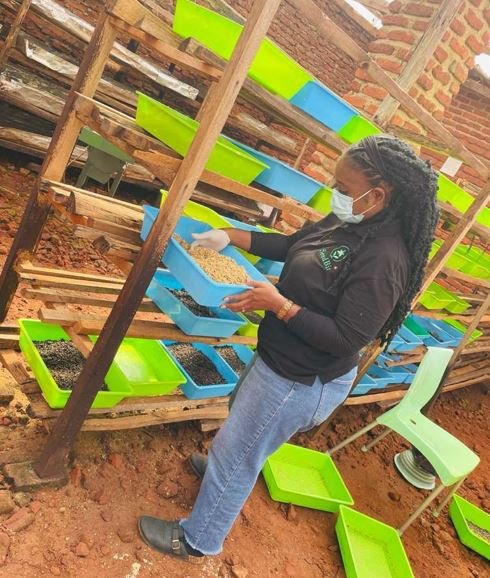
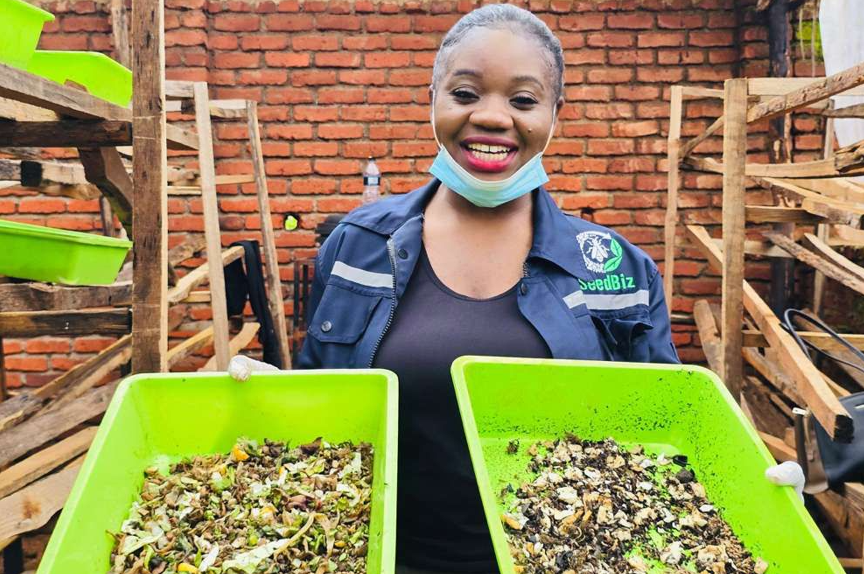
Tawonga Nyirenda at work in her Black Soldier Fly production facility, where organic waste is transformed into protein-rich livestock feed and organic fertiliser. Through her company, SeedBiz, she is turning agricultural waste into opportunity, helping farmers access affordable feed while promoting sustainable and climate-smart farming practices across Africa.
That realisation gave birth to SeedBiz.
The company now works at the intersection of food security, waste management, climate action, and community development by turning market waste, food leftovers, and agro-processing residues into useful agricultural products.
Nyirenda says the breakthrough came when she began to understand farming through the lens of a circular economy — a system in which waste is continuously reused rather than discarded.
“A circular economy is about designing systems where resources are not wasted, but are kept in use and turned into new value. In agriculture, this is very important because so much of what we call ‘waste’ can actually become part of the solution.”
Through SeedBiz, organic waste is converted into high-protein feed for poultry and livestock, while the residue left behind — known as frass — becomes organic fertiliser that can improve soil health and crop production.
“Through Black Soldier Fly farming, organic waste can be converted into high-protein livestock feed. The byproduct can be used as organic fertiliser, which farmers can use to reduce input costs. Waste can be managed more sustainably, and communities can benefit from a system that supports food security, climate action, and livelihoods at the same time.”
“That is the power of circularity,” she shared.
In a continent where rising feed prices continue threatening poultry production and food affordability, Nyirenda believes Africa must begin looking inward for solutions.
“For me, Black Soldier Fly farming is not only about producing affordable feed. It is about rethinking how agriculture works and about turning waste into opportunity, reducing pressure on farmers, improving soil health and helping build more resilient farming communities.”
Her work is now attracting attention from farmers and agricultural entrepreneurs across Africa interested in sustainable livestock feed alternatives.
During the discussion, Nyirenda explained that the model can be easily replicated across different African countries using locally available organic waste.
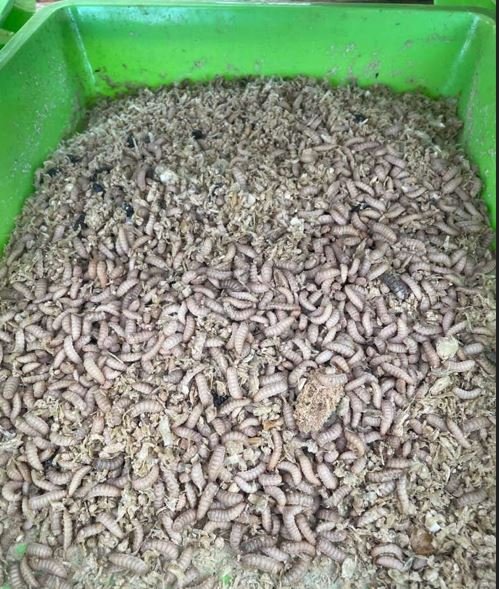
Products derived from recycled organic waste through Black Soldier Fly farming, including protein-rich livestock feed and nutrient-dense organic fertiliser. The innovative approach transforms waste into valuable agricultural inputs, reducing production costs for farmers while supporting sustainable food systems and environmental conservation.
“You can replicate it across Africa by using local organic waste, market or food waste to grow Black Soldier Fly Larvae (BSFL), which is then used to partially replace expensive poultry feed,” she explained.
Instead of changing everything at once, she advised that farmers can test it gradually to see results.
Despite growing interest in Black Soldier Fly farming, Nyirenda says many people mistakenly assume the business requires large capital investments.
“One thing I always tell people about starting Black Soldier Fly farming is, it is chilled,” she laughed.
“It does not require a big setup to start. Consistency matters more than scale.”
She says success depends less on size and more on discipline.
“BSF farming isn’t about having a big setup, it’s about managing the small details every day: feeding at the right time, keeping the right moisture levels, and maintaining a healthy breeding cycle.”
Nyirenda also believes one of the biggest misconceptions is that Black Soldier Fly farming is purely about insects.
“BSF farming is really a waste management system first, and an insect business second.”
As climate change, rising production costs, and food insecurity continue placing pressure on African agriculture, Nyirenda believes young people have an important role to play in reimagining the continent’s food systems.
“My hope for the future is to see more young people stepping into agriculture, not just as farmers, but as innovators and problem solvers because the future of our food systems depends on us thinking differently and acting boldly.”
Today, SeedBiz is expanding production to meet growing demand from farmers seeking affordable feed solutions and sustainable farming inputs.
But for Nyirenda, the business remains rooted in something much deeper than profit.
“What keeps me going is knowing that this work is bigger than me. It’s about families. It’s about farmers who just need a fair chance. It’s about creating systems that allow people not just to survive, but to thrive.”
Her message to young Africans facing setbacks is equally powerful.
“Don’t let one setback define your story. Sometimes what feels like the end is actually the beginning of something greater. So, start where you are. Use what you have and trust that your journey, even the difficult parts, has purpose.”