

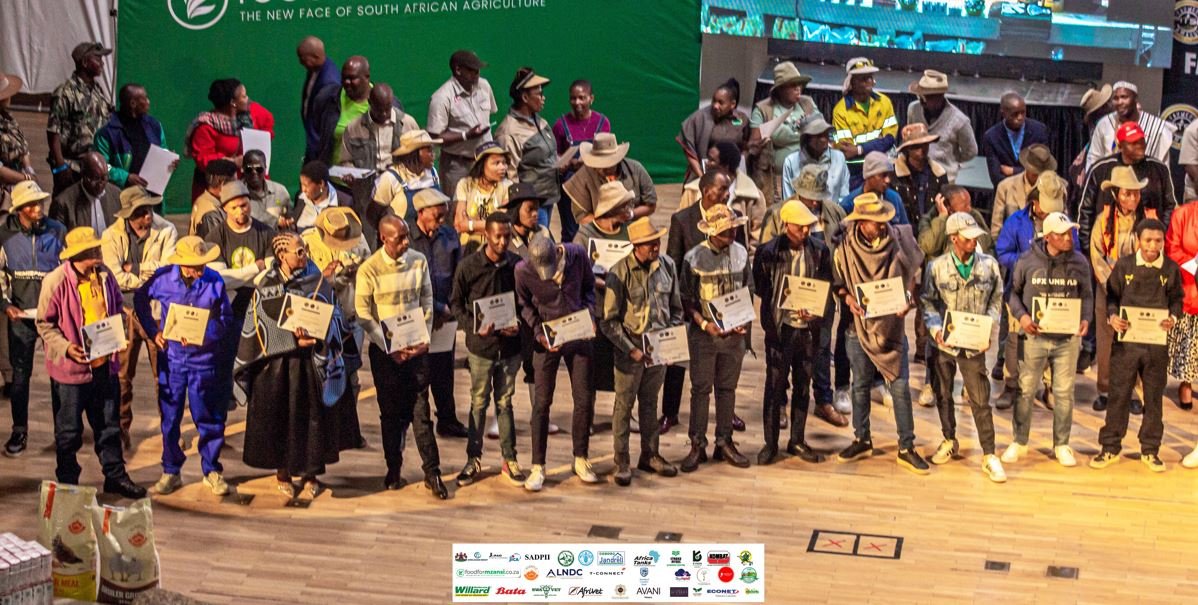

SADP II’s contribution to Farmers Pitso connected farmer recognition with investment in climate resilience, commercial production and stronger routes to market.
For Lesotho’s smallholder farmer, growing an enterprise requires more than the ambition to produce. It takes access to water, suitable equipment, technical knowledge and buyers, and the ability to keep operating when weather or rising costs put the business under pressure.
At Farmers Pitso Agriculture Week, those needs formed the foundation of a call to strengthen Lesotho’s agricultural enterprises. The Smallholder Agriculture Development Project II (SADP II) urged farmers to embrace climate-smart production, commercialisation and collective approaches to markets, while outlining interventions intended to support that transition.
The message also celebrated producers already demonstrating what is possible.
Held under the theme “Celebrating Excellence. Advancing Agriculture. Transforming Lives”, the 2026 programme brought farmers together with government, development partners and businesses to recognise achievement and discuss the conditions needed for further progress.
Speaking at the Farmers Pitso Agricultural and Excellence Awards, SADP II Project Director Mpaki Makara described the gathering as a place where shared challenges could become a basis for collective action.
“A pitso is more than just a meeting. It is a place of truth, unity and shared progress,” he said.
Makara acknowledged the pressures facing the sector: food insecurity, climate change, high production costs, limited finance and market access, and the need to attract young people into agriculture. Erratic weather, drought and soil erosion complicate production, while spending on seed, fertiliser and animal feed puts pressure on farmers before they earn a return.
Against that background, he said, SADP II seeks to help smallholders move towards more commercially viable and climate-resilient enterprises.
The project, funded by the Government of Lesotho, the World Bank and the International Fund for Agricultural Development (IFAD), is meant to support agricultural productivity, commercialisation and resilience.
Makara identified its matching grant programme as a key intervention, supporting farmers and agribusinesses to invest in productive assets and technologies.
He described investments involving tunnels, shade nets, livestock development, irrigation and other climate-smart approaches.
“We are not here for temporary handouts. SADP II is here to deliver sustainable solutions,” he said.
The distinction puts an enterprise’s performance over time at the centre of support. Equipment and infrastructure must help farmers produce effectively, manage risk and sustain an income.
Makara encouraged farmers to use irrigation schemes being rehabilitated through the project and adopt production methods that could help them withstand climate-related shocks.
He also connected production with the infrastructure and relationships needed to sell.
“Market linkages and growing premium crops or raising quality livestock is only half the battle,” he said.
SADP II, he explained, was working to strengthen commercial infrastructure and aggregation centres that could connect farmers with buyers. The project also encourages collective approaches to markets.
For smallholders, working together can create opportunities to assemble larger volumes and meet supply requirements that may be difficult for one farm to fulfil. Making that work requires coordination between producers, reliable handling systems and clear relationships with buyers.
Makara urged farmers to take ownership of the opportunities being created.
“Let us work together to restore our soil, commercialise our soil and build a food-secure Lesotho,” he said.
Agriculture, Food Security and Nutrition Minister Selibe Mochoboroane reinforced the importance of practical support during Farmers’ Pitso. He called for farmers to share their knowledge and for agricultural experts to work directly with producers in their fields.
His emphasis on field-based guidance recognised that advice must respond to actual conditions: the land available, the crop or livestock being managed and the difficulties a farmer encounters. He also highlighted appropriate mechanisation and properly planned infrastructure, including aggregation centres.
Those contributions connected the week’s discussions with the services farmers need after returning home.
For Seahlolo founder and Newsday Media Managing Director Lerato Matheka, the expanded event resulted from a partnership developed over several years.
“Our journey with the Farmers Pitso Awards started three years ago as sponsors, and they later approached us to work with them,” she said.
Matheka thanked the Farmers Pitso Foundation for entrusting her organisation with hosting the awards. She said the 2026 programme began with a clear vision and grew into four days connecting knowledge exchange, schools’ participation, public exhibition and recognition.
Delivering that expansion required substantial work.
“It was not easy organising it, especially because we were introducing a lot of things that we had not done before,” she said.
Matheka reported that organisers received 285 applications, with an independent panel of judges assessing entries. The final awards recognised 118 farmers across 44 categories.
She thanked the farmers who participated, acknowledging the commitment involved in presenting their work for scrutiny. Their entries brought the achievements of agricultural enterprises into public view and demonstrated interest in a platform dedicated to recognising excellence.
Matheka also acknowledged the Ministry of Agriculture, Minister Mochoboroane, ministry officials, SADP II and the companies that supported the programme.
“These are companies that heard me when I pitched the vision I had for the Farmers Pitso Awards,” she said.
Businesses from South Africa joined local sponsors, broadening the initiative’s support. Matheka viewed their participation as an indication of the potential to attract wider attention and investment to Lesotho’s agricultural sector.
The partnership with SADP II also saw the project’s excelling beneficiaries celebrated at the event, placing agricultural excellence recognition alongside a development agenda.
The project honoured its beneficiaries, highlighting support intended to improve farmers’ access to assets, technology, infrastructure and markets.
Farmers Pitso brought producers onto a national stage, where their achievements could encourage others and their challenges could be heard, while the ambition is an agricultural economy in which smallholder enterprises can grow, withstand shocks and provide dependable livelihoods.