

By Ntsoaki Motaung and Refiloe Molise
Lesotho is a country where many young people are searching for opportunities, while some are beginning to create them, starting from the ground up.
In Pitsing, Leribe, Rerereile Kamohi saw a lack of opportunities as a stepping stone to craft a story of success from a simple idea rooted in community care. An idea that would grow into a model for sustainable agriculture and rural transformation.
Not a trained agriculturalist but a social worker, Kamohi chose to confront poverty not only through the support systems available in her community but through production, dignity and self-reliance, using the very people she sees on a daily basis.
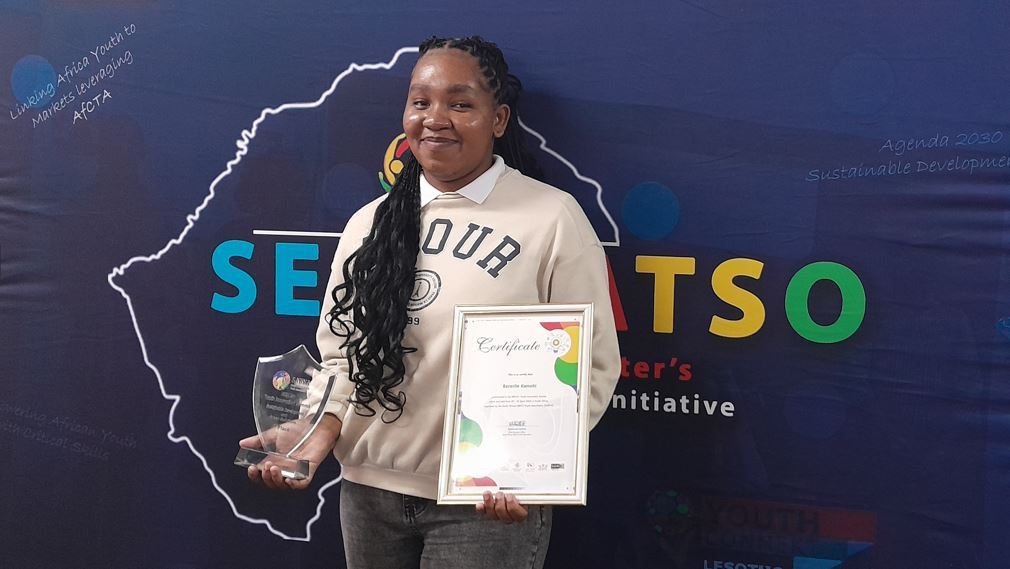
Her simple, innovative idea recently took her to the global stage at the BRICS Youth Innovation Summit in Pretoria, South Africa, where her project, Bashoeshoe Climate Smart Community Gardens, secured third place in the Sustainable Development and Green Innovation category.
For Kamohi, the recognition is not just an award but a validation of a deeply personal mission shaped by lived experience.
Kamohi’s path into climate-smart agriculture was anything but conventional.
“Bashoeshoe was an unexpected win because I am a social work person,” she said.
She added, “Many people did not think this idea would grow into something like this because I did not come from an agriculture or even climate change background.”
Her turning point came while volunteering in Motseki, in Leribe’s Pitsing area, where she worked closely with families struggling to make ends meet. What she encountered was not just poverty but the dependency of households that relied almost entirely on social grants, with little opportunity to generate their own income.
“As I was interacting with parents who were trying to make ends meet for their families, I realised they had no real means of living. They were relying completely on social grants,” she explained
“That is when I saw that I could become a bridge to help them create income for themselves instead of depending entirely on support.”
Determined to find solutions, Kamohi began building her knowledge from the ground up. She enrolled in online courses, attended leadership programmes and immersed herself in climate conversations wherever she could.
“Anywhere people were talking about climate change. I made sure I was there to learn, and that is what built my passion for this project,” she says.
She describes Bashoeshoe Climate Smart Community Gardens as an initiative designed to empower youth and women to produce food, generate income and build resilience against climate shocks.
Unlike traditional backyard gardening, the model is structured around shared community production.
“Bashoeshoe is designed as a centralised community land initiative where people come together to work one plot. We are targeting 100 participants, 50 youth and 50 other community members.”
The project is based in Leribe, often regarded as Lesotho’s agricultural hub due to its fertile soils and available land. It incorporates irrigated gardens, polytunnels, and greenhouses to ensure year-round production, even in unpredictable weather.
These controlled environments are critical in protecting crops from heavy rains and climate variability, allowing communities to move from subsistence to more stable, market-oriented production.
A key feature of the initiative she describes is the Lefupu model, a structured system that governs both production and participation.
“This model ensures that we can produce throughout the year, especially through our tunnels and greenhouses.
“Labour is organised deliberately. Youth participants are responsible for maintaining the gardens, harvesting crops and ensuring productivity. In return, access to produce is directly linked to contribution.
“If you do not work, you do not get anything,” Kamohi explained, noting that it encourages responsibility, but also ownership.
Beyond production, the initiative plays a critical role in linking farmers to markets, acting as an intermediary to ensure that produce does not go to waste and that participants can generate income from their work.
Kamohi’s breakthrough came when Bashoeshoe was selected as part of a six-member Lesotho delegation under the Sebabatso Youth Empowerment Initiative to represent the country at the BRICS+ summit.
Competing against innovators from across the Global South, she finished third, underscoring the competitiveness of locally developed solutions.
“Working with Team Lesotho made me realise that we have real potential as Basotho, and seeing other projects also showed me that we can go far; we just need to keep pushing and working towards our goals.”
Despite the recognition, the road ahead remains challenging.
“Access to funding is one of the biggest challenges we are facing to ensure sustainability,” Kamohi admits.
Rather than waiting for government intervention, she is actively pursuing partnerships to advance the project.
“We cannot wait for others. We need to use the resources we already have and build from there.”
She has already begun working with youth-led organisations, including climate-focused groups involved in tree planting and irrigation, to bring the project to life.
Beyond its immediate impact, Bashoeshoe is closely aligned with global development priorities, particularly poverty reduction, food security and climate action.
“We are not going to use anything that is harmful to the environment,” Kamohi emphasised, highlighting the project’s commitment to organic and sustainable production.
Her work has also drawn recognition from Pitso Lesaoana, Minister of Gender, Youth and Social Development, who praised youth-led innovation as a driver of national progress.
“Youth are not just our greatest asset, they are the driving force of innovation and progress,” he said.
The minister lauded Kamohi’s journey, saying her project reflects a broader shift taking place across Lesotho, where young people are not only identifying problems but building solutions rooted in their communities.