



By Seahlolo Reporters
A year after concerns about industry collapse, Lesotho’s poultry sector is showing renewal following the launch of the Poultry Development Policy and the Lesotho Poultry Industry Association (LePIA), signalling a new direction for the sector.
For years, poultry farmers struggled with high feed costs, poor infrastructure, limited financing, weak government coordination, and heavy import volumes, all of which stifled local production. Industry players had warned that, without urgent intervention, Lesotho’s ambition of self-sufficiency would remain out of reach.
Stakeholders believe the new policy and the industry body are crucial steps toward revitalising the sector.
The Ministry of Agriculture, Food Security and Nutrition launched the Poultry Development Policy and the Lesotho Poultry Industry Association (LePIA) during an event with stakeholders. Attendees included UNDP, Standard Lesotho Bank, FinMark Trust, LNDC, and poultry farmers from across Lesotho.
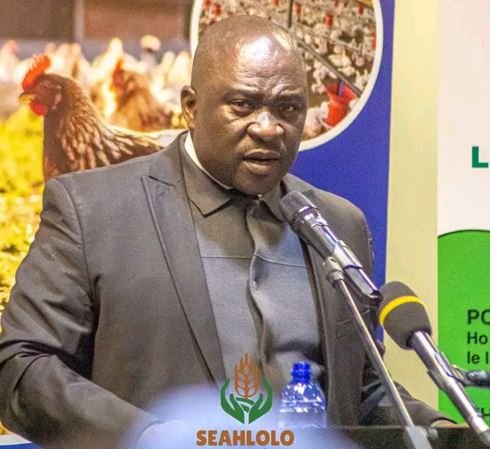
Launching the policy and association, Minister of Agriculture, Food Security and Nutrition, Hon. Selibe Mochoboroane, said the occasion represented far more than the unveiling of policy documents.
“This event is not only about a policy document or association. It lays the foundation for a transformed poultry sector. The sector feeds Basotho, creates jobs, empowers farmers, strengthens food security, and keeps wealth within communities,” said Mochoboroane.
He added that the launch marked “decisive steps towards building a self-sufficient, commercially viable, and resilient poultry sector that contributes to inclusive economic growth and national development.”
The minister noted that poultry remains one of the most accessible and affordable sources of protein in Lesotho and also offers one of the fastest opportunities for income generation, enterprise development, and employment creation.
The launch is especially timely given longstanding concerns about Lesotho’s heavy reliance on imported poultry products—a challenge that repeatedly exposes the country’s food systems’ vulnerability and weakens local producers.
According to the Poultry Development Policy, Lesotho imports approximately 24,000 metric tonnes of poultry meat each year, worth more than US$20 million. Notably, in 2025, poultry imports reached an estimated value of around M653 million, highlighting the country’s continued dependence on external markets.
The policy further notes that, by 2030, national demand for chicken is projected to exceed 30,000 metric tonnes. Currently, local production supplies only about 5 per cent of this demand, leaving nearly 95 per cent of poultry meat consumed in Lesotho imported, mainly from South Africa. Consumption is increasing, with consumption currently exceeding 53 million eggs, or approximately 1.7 million trays each year. The government reports that investment and targeted support are gradually improving the local egg supply.
Mochoboroane warned that the country continues to lose significant economic opportunities through imports.
“Every truckload of imported chicken arriving in Lesotho represents money leaving the country, and opportunities lost for Basotho farmers, feed producers, transporters, processors, traders, and young people seeking employment,” he said.
The minister acknowledged that the poultry industry continues to face structural barriers that have for years constrained growth and competitiveness. These include the lack of certified abattoirs and processing facilities, high production and input costs, limited access to finance, poor infrastructure, and low levels of private sector investment.
These challenges have not gone unnoticed, as poultry farmers and stakeholders previously highlighted that fragmented representation and a lack of coordinated policy implementation had severely undermined the sector’s growth potential.
Nonetheless, Mochoboroane expressed optimism, saying that despite these obstacles, the new policy provides a realistic roadmap for turning the poultry sector into a major pillar of Lesotho’s agricultural economy.
“The poultry sector must become a pillar of our agricultural economy, driving employment and income. Our policy sets ambitious, achievable targets for 2030, including raising local poultry meat production from five to 60 per cent of national consumption,” he said.
He further stated that the policy aims to boost national table egg production to meet 100 per cent of domestic demand by 2030. It also targets a reduction in poultry import dependence, from a current 95 per cent of consumption to 55 per cent by 2030.
The strategy aims to create about 18,500 decent jobs, particularly for youth and women. By 2030, poultry production is expected to support over 18,700 full-time jobs, with more than 10,000 of those jobs directly benefiting rural and low-income households.
“The poultry industry is about much more than meat and eggs. It drives jobs, nutrition, industrialisation, youth and rural development, and strengthens national food security and sovereignty,” Mochoboroane said.
Representing development partners, Dr Jacqueline Olweya of UNDP congratulated Mochoboroane on his appointment as Minister of Agriculture, noting that his background in health could strengthen the sector’s response to livestock and food-related challenges.
“Moving from Health to Agriculture means you bring a health perspective. This is valuable for a sector challenged by crop and animal diseases. We believe the poultry and agriculture industry will prosper,” Olweya said.
“Your health ministry skills will benefit farming, which now faces issues such as foot-and-mouth disease.”
Olweya said the statistics surrounding Lesotho’s poultry sector reminded her of past periods when the country experienced shortages of poultry products.
She emphasised that with the policy and association in place, all stakeholders must now take ownership and act decisively to achieve the sector’s 2030 goals. She urged commitment and prompt action to turn plans into measurable progress.
She called on every stakeholder to step up, actively engage, and pursue new opportunities within the poultry value chain, stating that the time for action is now.
Meanwhile, the formation of the association was described by LePIA interim committee representative Kelebohile Lesisanyane as a historic breakthrough after years of fragmentation within the poultry industry.
Lesisanyane said LePIA emerged from a two-day dialogue in Maseru in 2025, themed “One Country, One Representative Body.” The event gathered 50 participants from across the poultry value chain, including farmers, processors, traders, distributors, financiers, and development partners.
“LePIA is a key turning point. The sector has been divided for too long. Through LePIA, Lesotho now builds a coordinated, self-reliant industry to empower Basotho and strengthen food security,” Lesisanyane said.
He said the association’s mission is to unite and represent all poultry value chain actors, from smallholders to large processors, through a single, inclusive national platform.
Closing the event, Mochoboroane reflected on his experience in the health sector and linked food production directly to national wellbeing.
“Non-communicable diseases like cancer affect lives. Healthy living starts with healthy food. We can produce for ourselves and prevent diseases. Good food is traceable, whether crops or livestock,” he said.
He further called on financial institutions and development agencies, including LNDC and Standard Lesotho Bank, to increase investment in local food production.
Opportunities in the poultry industry are vast, but they need financial support. Institutions must work with producers to boost food production and cut imports,” he said.
Mochoboroane concluded by urging poultry farmers to remain committed to rebuilding the industry.
“Reducing imports requires time and effort. Producers must work persistently to raise local production from five to 60 per cent. Commitment and investment are key,” he said.