


When you arrive at Thabana-Mokhele in Botha-Bothe in the late afternoon, the farm does not announce itself loudly. It unfolds gradually, green rows of vegetables, the steady movement of chickens and a quiet rhythm of work that seems to run on instinct rather than instruction.
In the middle of it all is ‘Maatlehang Matjelo, moving from one task to another with the familiarity of someone who no longer separates life from land.
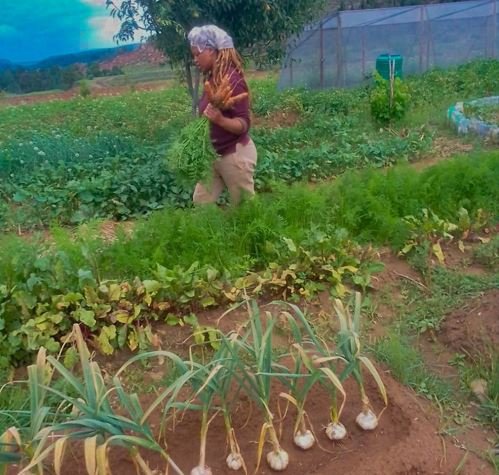
On this particular Monday after five o’clock, the light is soft but still strong enough to reveal every detail of her routine. She is bent over her crops, checking leaves one by one, testing soil with her fingers and shifting between vegetables and poultry without pause. There is no sense of performance in her movements, only practice.
At first glance, it is hard to reconcile this scene with the profession she once trained for. Matjelo is a diploma holder in Secondary Education from the Lesotho College of Education. She stood in front of classrooms, taught learners and once measured her life through timetables and syllabi. That chapter, however, has not defined her present.
After five years in farming, she speaks about the land not as a replacement for teaching but as a continuation of learning in a different form. The discipline remains, but the classroom has changed.
“Farming has taught me patience, planning and hard work; skills I first learned at college but now apply in a different way,” she says.
“For me, learning never stops, whether in a classroom or on the land, I keep learning.”
Her yard is a layered space of production; spinach, cabbage, onions, potatoes, and other vegetables grow in carefully managed sections, while a corrugated-iron poultry structure hums with activity nearby. The chickens are not passive assets; they are part of a system that demands daily attention, adjustment and care.
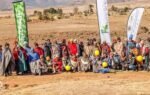
Women from the surrounding community move through the space on harvesting days, helping with slaughtering, cleaning and preparing chickens for sale. The arrangement is both practical and social. The work is distributed, and outcomes are shared in small, informal ways that sustain both livelihood and cooperation.
“Through this arrangement, the women in my community show strong support for my farm,” Matjelo says.
Her poultry work has not been without disruption. At one point, Newcastle disease swept through her flock during the festive season, wiping out about 64 chickens. It was a moment that forced her to confront the fragility of livestock farming in a very direct way.
“I had only heard of such stories, but when it happened to me, the reality of risks in agriculture was given life. It was very painful,” she narrates.
Even the surviving birds were weakened, and the farm briefly lost its rhythm. But the setback did not translate into withdrawal. Instead, it pushed her toward more structured, preventive practices, especially around vaccination and early response.
“You have to prevent the disease from happening. Once I notice something unusual with the chickens, I act quickly and go to the agricultural chemist to consult professionals.”
Despite the loss, she still managed to generate income during that period from vegetables and the few surviving chickens, which she sold. It was not a full recovery, but it was enough to reinforce her confidence in the farm’s long-term potential.
Support from agricultural programmes has also helped stabilise her work. She is a beneficiary of the Smallholder Agriculture Development Project (SADP), which has provided shade nets to protect crops from the weather and birds. More recently, she constructed a borehole to secure access to water, a decision driven by repeated droughts and unreliable water sources challenges.
These interventions have not eliminated difficulties, but they have reduced vulnerability. For Matjelo, that difference is important. Still, expansion remains a priority.
She is currently seeking additional funding to scale her farming activities and has already taken steps to increase production by hiring two additional field workers. Growth, for her, is not conceptual. It is physical, measured in land, inputs and labour.
Her confidence in farming today contrasts sharply with her early hesitation. Like many women entering agribusiness, she initially struggled with visibility and confidence in selling her produce directly.
“Women are sometimes shy to sell their produce, and that was me when I first started. I was afraid to go out and meet people. I felt like giving someone else the produce to sell on my behalf. With time, however, I gained confidence and managed to do it myself.”
That shift has since changed the trajectory of her work. Customers now come directly to her farm.
“Word of mouth has helped me expand my small but steady market. I also sell to local hawkers who collect vegetables directly from my yard.”
Her ambitions, however, extend beyond what she currently produces. Matjelo speaks about integrating piggery and even developing a fish pond as part of her long-term plans.
“These ideas are not detached dreams; they are extensions of a growing understanding of farming as a system rather than a single activity. My husband, who is an agriculture teacher, has also influenced my different approaches in how I work, reinforcing the idea that farming can be both practical and structured,” she said.
There is a moment in her conversation where her position becomes clear, not as someone experimenting with agriculture, but as someone committed to it as a life direction.
“I feel satisfied. Even if they say, ‘Here is the grant to be a teacher again,’ I will not return to teaching,” she says.
The statement is not framed as a rejection of her past profession, but as an acceptance of her present reality: “Teaching gave me structure, but farming is giving me my ownership.”