



By Seabata Mahao
MASERU – As Lesotho prepares for upcoming Public–Private Dialogue (PPD) sessions in 2026, a renewed ambition is taking shape, “Restoring the Mountain Kingdom’s historic position as a leading agricultural exporter in Southern Africa”.
The vision was forcefully articulated by Chaba Mokuku, Managing Director of the Competitiveness and Financial Inclusion (CAFI) Project, who challenged stakeholders to go beyond incremental reforms and embrace a transformative agenda for agriculture. Mokuku’s call comes at a time when government and private-sector leaders are seeking to reverse decades of declining agricultural output, which turned Lesotho from a food exporter into a net food importer.
In the 19th century, Lesotho was a significant supplier of grain and mohair to South African mining camps. However, structural constraints, declining productivity, and weak policy coordination gradually eroded that position. Today, the country depends heavily on food imports, particularly cereals, dairy, and horticultural products from South Africa.
A turning point emerged in October 2024 with the signing of a Memorandum of Understanding (MoU) between the Government of Lesotho and the private sector, reinforced by a Public–Private Partnership (PPP) meeting in December 2025. The MoU establishes a predictable, institutionalised platform for dialogue, aimed at strengthening policy coherence, transparency, and consistency in implementing investment-climate reforms.
“This is about reclaiming what Lesotho was once capable of,” Mokuku said, stressing that sustained collaboration is essential.
Restoring Lesotho’s status as an exporter of high-quality agricultural commodities, he noted, can only be achieved through coordinated action linking policy reform with practical, on-the-ground support for farmers and agribusinesses.
The MoU operates within the framework of the World Bank-funded CAFI Project, which runs from July 2022 to June 2028 with financing of M838,551,000 (US$52.5 million).
CAFI has established two strategic Thematic Working Groups (TWGs), Textile and Apparel, and Agriculture and Food Security, tasked not only with dialogue but with delivering measurable reforms across key value chains.
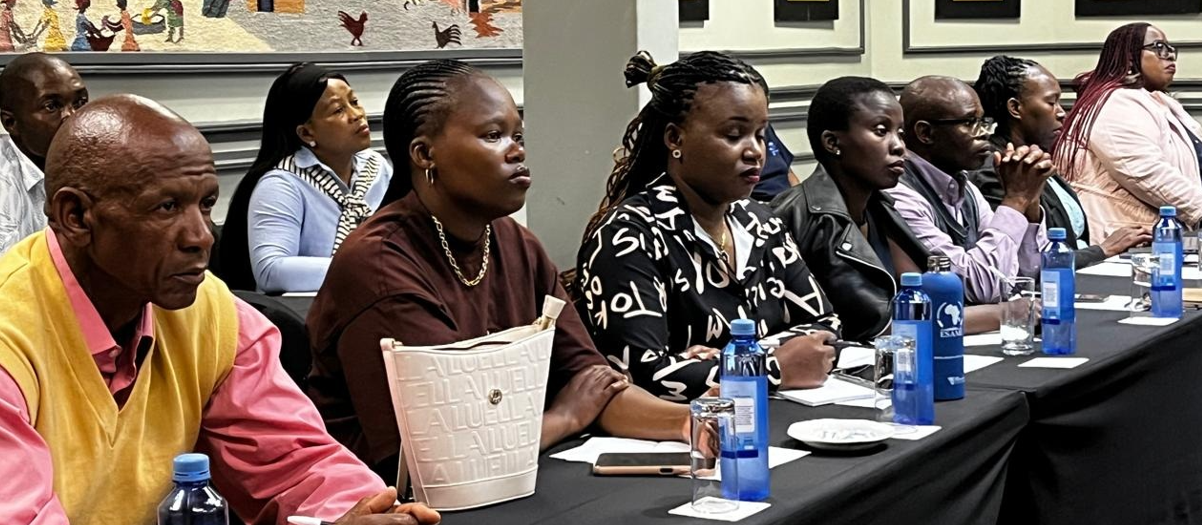
Speaking on behalf of the Principal Secretary of the Ministry of Agriculture, Food Security and Nutrition at a recent Agriculture and Food Security TWG meeting, Deputy Principal Secretary Johanne Masiea emphasised that the platform is more than a discussion forum: “This TWG is not a talk space; it is an accountability mechanism. We expect concrete identification of bottlenecks, prioritisation of high-impact reforms, and measurable progress that strengthens our farmers, agribusinesses and national food security.”
Farmer organisations and sector institutions have welcomed the platform.
Khotso Lepheane of the Lesotho National Farmers Union (LENAFU) described the TWG as long overdue, citing, “Our producers face persistent constraints, from high input costs to limited market access. Only a coordinated reform process will unlock the sector’s full potential. We stand ready to contribute evidence, priorities and solutions that strengthen commercial agriculture while protecting smallholder livelihoods.”
Similarly, Abiel Mashale of the Lesotho National Dairy Board (LNDB) noted that the collaboration could stabilise and modernise the dairy value chain.
“The sector needs clear regulatory alignment, upgraded production systems, and predictable standards that enable local farmers and processors to compete regionally. This TWG provides the structure required to drive those reforms.”
From an economic perspective, the MoU is significant. Agricultural economist ’Mamoeketsie Loke of the Ministry of Agriculture explained that the agreement marks a potentially decisive shift in how agricultural policy is designed, implemented, and monitored. “Agriculture remains economically and socially important in Lesotho, employing a large share of rural households and acting as a safety net for food security. Yet its contribution to GDP is modest and declining. Productivity is low, and the country remains structurally dependent on food imports,” she said. Loke highlighted key constraints, including high production costs, limited mechanisation, climate variability, degraded soils, fragmented value chains, regulatory bottlenecks, and weak private investment in agro-processing, irrigation, cold chains, and storage.
Despite these challenges, she emphasised that Lesotho has strong latent comparative advantages, high-quality livestock and dairy potential, niche horticultural crops, seed potatoes, wool and mohair, and proximity to South Africa’s large consumer market. “The problem has not been potential, but coordination and execution,” Loke said.
According to Loke, the Agriculture and Food Security TWG can transform the sector in three critical ways: shifting reforms from policy intent to delivery, lowering transaction costs for farmers and agribusinesses, and attracting private investment. Instruments such as CAFI and the Lesotho Enterprise Assistance Programme (LEAP) are crucial, providing matching grants for machinery and modern technologies that reduce entry barriers and encourage private capital.
“If implementation remains credible, we can expect improved productivity, stronger domestic value chains, reduced imports of products we can competitively produce, and greater regional integration within SACU and SADC markets,” Loke said. She cautioned, however, against reform fatigue and stressed the need to deliberately include smallholders in the process.
CAFI-supported initiatives are already bearing fruit. The project has incubated 150 enterprises—92 women-led and 111 youth-led—creating over 1,200 jobs.
It has also established the Lesotho Horticultural Incubation and Training Centre at Mahobong in Leribe district, aimed at scaling commercial fruit farming for domestic and export markets.